
Monochrome LCD Types: TN vs HTN vs STN vs FSTN vs DFSTN vs VA
Quick answer: monochrome LCDs are grouped by their liquid crystal mode. TN (twisted nematic) is the simplest and cheapest, with a narrow viewing angle. HTN (high twisted nematic) gives better contrast and viewing angle at a similar cost and is the most common choice for segment displays. STN (super twisted nematic) can be multiplexed much further, with a yellow-green, gray or blue look. FSTN adds a compensation film for a near black-on-white appearance, and DFSTN uses a double film, usually in negative mode with a backlight. VA (vertical alignment) gives the deepest black background for bright-on-black negative displays.
All six are used in the SuccessLCD catalogue of 89 monochrome LCD references with a stated mode: 41 HTN, 13 TN, 11 STN, 11 FSTN, 9 DFSTN and 4 VA.
Comparison Table
| Mode | How it works | Typical look | Contrast and viewing angle | Duty in our catalogue | Relative cost |
|---|---|---|---|---|---|
| TN | Liquid crystal twisted 90° between the plates | Dark gray segments on a light gray background; negative versions exist | Lowest; narrow viewing angle | 1/2 to 1/8, mostly 1/4 | Lowest |
| HTN | Twist increased to roughly 110°–130° | Darker segments on gray; blue or black negative versions | Better than TN, wider viewing angle | Static to 1/8, mostly 1/4 | Low |
| STN | Twist of about 180°–270°, giving a steep electro-optical curve | Yellow-green, gray or blue background; blue negative is common | Good; supports high multiplexing | 1/4 to 1/33 | Medium |
| FSTN | STN plus a retardation (compensation) film that cancels the color | Near black segments on a white-gray background | Higher contrast, neutral color | 1/3 to 1/64 | Medium to higher |
| DFSTN | STN with a double compensation film | Usually negative: white or colored segments on a dark background | High contrast in negative mode | Static to 1/32, mostly 1/8 | Higher |
| VA | Molecules stand vertical with no voltage; crossed polarizers give a very dark off state | Negative: bright segments on a deep black background | Highest contrast; wide viewing angle | 1/4 | Highest |
Cost order is a general guide for comparable glass size and construction. The final price depends far more on size, connection, backlight and quantity than on the mode alone.
TN LCD
A twisted nematic cell rotates polarized light by 90° when no voltage is applied. It is the original LCD mode and is still used where cost and simplicity matter more than viewing angle: remote controls, scales, meters and toys. TN works well with static and low-multiplex drive.
Examples: S3423D reflective TN water-meter display (1/4 duty, 1/3 bias, 3.0 V), S3689D TN body-fat-scale display with heat-seal connection (1/5 duty), and S3487D TN negative water-purifier display. Browse TN LCD references.
HTN LCD
High twisted nematic glass increases the twist angle beyond 90°. The result is better contrast and a wider usable viewing angle than TN, with almost the same cost, and enough margin for 1/4 to 1/8 duty. That balance is why HTN is the largest group in our catalogue: thermostats, motorcycle instruments, appliance controls, medical and test equipment.
Examples: S3984D HTN thermometer display (1/5 duty), S3961D HTN thermostat display (1/8 duty, 1/4 bias), S3960D four-digit HTN display with static drive, and S1702D long blue negative HTN treadmill display. Browse HTN LCD references.
STN LCD
Super twisted nematic glass uses a much larger twist. Its transmission changes sharply around the threshold voltage, so it keeps usable contrast at high multiplex ratios. That is what makes character and graphic LCDs possible. The birefringence of the cell gives STN its characteristic color: yellow-green or gray in positive mode, blue in negative mode.
Examples: S3543D yellow-green STN instrument display, S3203D blue negative STN refrigerator display, and S4132D 20 × 4 STN character glass at 1/16 duty, 1/5 bias. Browse STN LCD references.
FSTN LCD
Film-compensated STN adds a retardation film that cancels STN’s color shift, so the display looks close to black on white. Contrast improves and the appearance suits instruments and products where a neutral look matters. FSTN is also used for high-duty dot-matrix glass.
Examples: S4745D reflective FSTN caliper display, S4261D FSTN instrument display at 1/8 duty, S3420D FSTN segment module with FPC and backlight, and S2983D dot-matrix chip-on-glass FSTN at 1/64 duty. Browse FSTN LCD references.
DFSTN LCD
DFSTN (double-film STN) uses two compensation films. In our catalogue every DFSTN reference is a negative display: the background stays dark and the segments light up with the backlight. It gives a crisp, high-contrast look in vehicle accessories, thermostats and kitchen thermometers.
Examples: S3438D and S3490D DFSTN tire-pressure displays (1/8 duty, 1/4 bias), S4404D DFSTN food-thermometer display, and S3999D DFSTN thermostat display.
VA LCD
In a vertical alignment cell the liquid crystal molecules stand perpendicular to the glass when no voltage is applied. Between crossed polarizers this gives an almost perfectly dark off state, so VA is the first choice for negative displays with a deep black background, including replacements for vacuum fluorescent displays. See VA vs IPS and VA segment LCDs and VFD vs LCD.
Examples: S2238D compact VA negative display with a 23-contact FPC, and S1386D VA massage-device display. Browse VA LCD references.
Positive Vs Negative Mode
- Positive mode: dark segments on a light background. It can be reflective, transflective or transmissive, so it works with or without a backlight and is easy to read in daylight.
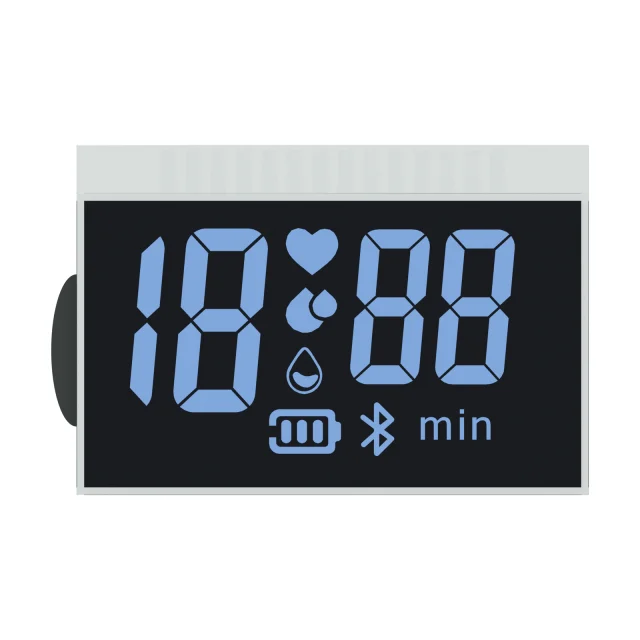
- Negative mode: light segments on a dark background. It needs a backlight, so it is transmissive. It stands out in dim surroundings and gives the “glowing digits” look of a VFD.
Watch the one-minute video comparing positive and negative LCDs on real SuccessLCD samples.
Reflective, Transflective And Transmissive
The rear polarizer decides how the display uses light:
| Optical mode | Light source | Best for | Example |
|---|---|---|---|
| Reflective | Ambient light only, via a reflector behind the glass | Lowest power, daylight readability, battery products | S4745D caliper, S3457D media player |
| Transflective | Ambient light and a backlight | Products used both outdoors and in the dark | S3915D speed instrument, S4032D thermostat |
| Transmissive | Backlight only | Negative displays and indoor products that are always lit | S3440D HTN negative instrument display |
More detail: transflective LCD display.
How To Choose An LCD Mode
- Start from the content. Few digits and icons can use TN or HTN at low duty. Many segments, characters or dots need STN or FSTN.
- Decide positive or negative. Daylight and battery products usually use positive reflective or transflective glass. A dark, glowing look needs negative glass with a backlight; choose VA or DFSTN for the deepest black.
- Check the viewing angle. TN has the narrowest usable cone; HTN, FSTN and VA are more forgiving. The viewing direction, often 6 o’clock or 12 o’clock, must match how the product is mounted.
- Match the driver. Duty, bias and voltage must suit the controller; see segment LCD duty and bias.
- Consider temperature. Contrast and response change with temperature; check the operating range on the drawing.
SuccessLCD designs custom segment LCDs in all six modes and recommends the mode after reviewing the artwork, lighting, driver and environment.
Video: Monochrome LCD Types On Real Samples
This SuccessLCD explainer compares TN, HTN, STN, FSTN, DFSTN and VA, shows one real SuccessLCD sample of each mode, and explains positive and negative glass and how to choose a mode.
Monochrome LCD Type FAQs
What is the difference between STN and FSTN?
FSTN is STN with an added retardation film. The film cancels the yellow-green or blue tint of STN, so FSTN looks close to black on white and has higher contrast, at a somewhat higher cost.
Is HTN better than TN?
For most segment displays, yes. HTN has a larger twist angle, giving better contrast and a wider viewing angle than TN at a similar cost. TN remains a good low-cost choice for simple, low-duty displays.
What does DFSTN mean?
DFSTN means double-film STN: STN glass with two compensation films. It is often used in negative mode, with bright segments on a dark background and a backlight.
Which monochrome LCD type has the best contrast?
VA gives the deepest black background and the highest contrast, which is why it is used for negative displays and VFD replacements. Among positive displays, FSTN gives a near black-on-white appearance with good contrast.
What is a negative LCD?
A negative LCD shows light segments on a dark background. It needs a backlight because the background blocks light; the segments let the backlight through. Positive LCDs show dark segments on a light background.
Which LCD type is used for character and graphic displays?
STN and FSTN, because they keep usable contrast at high multiplex ratios such as 1/16 duty for a 20 × 4 character display or 1/64 duty for a dot-matrix display.
Not sure which mode suits your product? Send the artwork or a sketch, the lighting conditions, driver and operating temperature. Send your display requirements for an engineering review, or browse monochrome LCD references. For a custom glass or LCD mode, see custom LCD modules.