
Driver and viewing direction
The reference uses 1/5 duty, 1/3 bias at 3.0 V and 64 Hz, with a 6 o'clock viewing direction. Confirm the driver waveform and reading orientation for your project.
Navigate
Rotate, zoom and inspect the product. Loads on request.
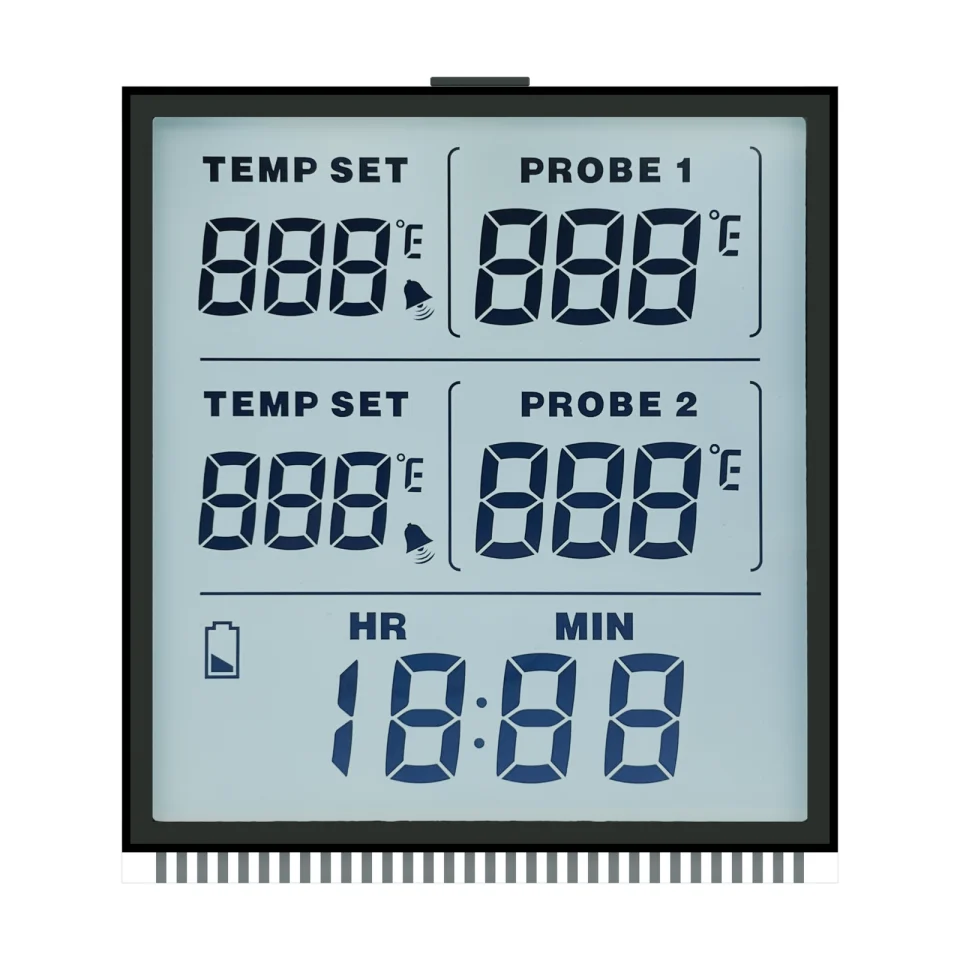
Front product rendering of S3984D, showing TEMP SET, PROBE 1 and PROBE 2 fields with an HR/MIN timer on a white background.
OEM DISPLAY REFERENCE
S3984D combines TEMP SET, PROBE 1 and PROBE 2 fields with an HR/MIN timer. The drawing specifies HTN, positive mode and 1/5 duty, 1/3 bias at 3.0 V.
Images, 3D geometry and listed parameters are OEM reference information. Final dimensions, electrical requirements, optical configuration and construction are confirmed for your project.
Short product video. Playback starts when you press play.
01 / REFERENCE CONFIGURATION
A reference configuration for discussing your LCD project. Final specifications are subject to project confirmation.
| Model reference | S3984D |
|---|---|
| Display mode | HTN, positive |
| Drive condition | 1/5 duty, 1/3 bias |
| LCD operating voltage | 3.0 V |
| Frame frequency | 64 Hz |
| Viewing direction | 6 o'clock |
| Operating temperature | 0 °C to +50 °C |
| Storage temperature | -10 °C to +60 °C |
| Front polarizer | Transmissive, adhesive |
| Rear polarizer | Transmissive, adhesive |
| Connection | Elastomeric connector |
| Minimum viewing area | 38.20 × 41.10 mm |
02 / OEM DESIGN
Bring your requirements. We will review the configuration with you.
The reference uses 1/5 duty, 1/3 bias at 3.0 V and 64 Hz, with a 6 o'clock viewing direction. Confirm the driver waveform and reading orientation for your project.
Plan the housing around the tall glass and edge contacts. Keep the 38.20 × 41.10 mm minimum viewing area clear.
03 / APPLICATION DIRECTION
This reference shows temperature setpoints, two probe fields and a timer. The folder groups it with temperature/humidity displays; humidity measurement is not established for this artwork.
ENGINEERING NOTES
How S3984D relates to LCD mode, drive, connection and integration choices, with links to the SuccessLCD engineering guides.
High twisted nematic glass: better contrast and a wider viewing angle than TN at a similar cost. Compare TN, HTN, STN, FSTN, DFSTN and VA →
5 common electrodes share the segment lines. Set the controller to the duty, bias, voltage and frame frequency on the drawing. Duty and bias explained →
An elastomeric connector presses the glass contacts against PCB pads; the housing or a bracket provides the clamping force. LCD connection types →
04 / PRODUCT SUPPORT
No. This page describes an LCD reference. Sensors, control electronics and firmware are specified separately.
The displayed legends belong to this reference. Different digits, wording or symbols are confirmed as a custom variant for your project.
YOUR NEXT LCD PROJECT
Share your required display content, enclosure space, drive arrangement, operating environment and target quantity.


