
Wide Temperature Segment LCD: Design Guide for −40 °C to +80 °C
Quick answer: A wide-temperature segment LCD keeps readable contrast and acceptable response across a range such as −30 °C to +80 °C, instead of the −20 °C to +70 °C of a standard industrial display or 0 °C to +50 °C of a consumer one. Temperature changes the liquid crystal itself: in the cold it becomes viscous and slow, and in the heat its threshold voltage falls until unselected segments start to show and, above the clearing point, the display stops working until it cools.
Wide-temperature designs therefore combine a suitable liquid crystal mixture, a low duty ratio for voltage margin, drive voltage compensation, and polarizers and seals rated for the heat. In the SuccessLCD catalogue, every segment display reference rated to −30 °C or colder uses 1/4 or 1/8 duty.
Operating Temperature Classes
| Class | Typical operating range | Typical use |
|---|---|---|
| Consumer | 0 °C to +50 °C | Indoor appliances, toys, clocks |
| Standard industrial | −20 °C to +70 °C | Meters, instruments, indoor controls |
| Wide | −30 °C to +70 °C or +80 °C | Vehicle instruments, outdoor meters, tire-pressure monitors |
| Extended | −40 °C to +80 °C | Outdoor equipment in cold climates, heavy machinery |
The storage range is wider than the operating range and covers transport and unpowered periods. The display does not have to look correct at storage extremes, but it must recover without damage when it returns to the operating range.
Wide-Temperature References In The SuccessLCD Catalogue
These references are published with their drive conditions and ratings. They show how wide-temperature segment displays are usually built: HTN, FSTN or DFSTN modes and low multiplex ratios.
| Reference | Mode | Drive | Operating | Storage |
|---|---|---|---|---|
| S4499D | FSTN, positive | 1/4 duty, 1/3 bias, 3.3 V | −40 °C to +80 °C | −40 °C to +85 °C |
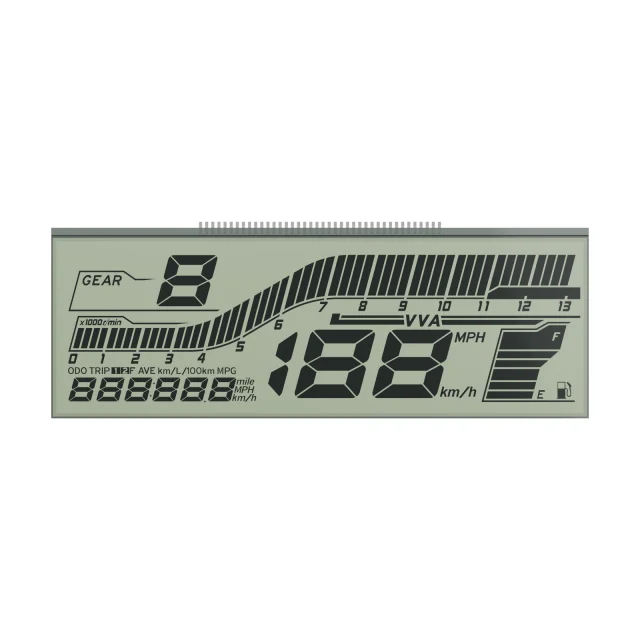
| S3440D speed and odometer display | HTN, negative | 1/4 duty, 1/3 bias | −30 °C to +80 °C | −40 °C to +90 °C |
| S3490D tire-pressure display | DFSTN, negative | 1/8 duty, 1/4 bias | −30 °C to +80 °C | −40 °C to +90 °C |
| S3675D vehicle instrument display | HTN | 1/4 duty, 1/3 bias | −30 °C to +80 °C | −35 °C to +85 °C |
| S04778D instrument display | HTN, positive | 1/4 duty, 1/3 bias | −30 °C to +80 °C | −40 °C to +85 °C |
| S4007D | HTN, positive | 1/8 duty, 1/4 bias, 3.3 V | −30 °C to +80 °C | −40 °C to +90 °C |
| S4800D | DFSTN, negative | 1/8 duty, 1/4 bias, 3.3 V | −30 °C to +80 °C | −40 °C to +85 °C |
| S4772D | HTN, positive | 1/4 duty, 1/3 bias, 5.0 V | −30 °C to +70 °C | −40 °C to +80 °C |
| S3986D power display | HTN, positive | 1/8 duty, 1/4 bias | −25 °C to +70 °C | −30 °C to +75 °C |
Other references with −30 °C to +80 °C ratings include S3676D, S3683D and S04799D; S04805D and S04830D are rated −30 °C to +70 °C. Ratings apply to the reference as published; a custom design is confirmed from its own specification.
What Happens In The Cold
As the temperature falls, the liquid crystal’s viscosity rises and segments take longer to switch. A display that changes in tens of milliseconds at room temperature can take a second or more near its low limit, depending on the material. Digits that change quickly then smear or leave traces of the previous value.
- Static icons look fine, so test with changing numbers, not a fixed image.
- Contrast also drops at a fixed drive voltage, because the liquid crystal needs more voltage to switch when cold.
- Below the storage limit the material can change phase, and the display may not recover.
- For starts colder than the display’s rating, some designs add a heater behind the glass; that is a system decision with its own power budget.
Our article on LCD smearing in the cold explains how to write acceptance limits for cold response rather than relying on an operating-temperature rating alone.
What Happens In The Heat
- Lower threshold voltage: the voltage needed to switch a segment falls as temperature rises. At a fixed drive voltage, unselected segments start to darken and show faintly, a form of crosstalk or ghosting.
- Clearing point: above the liquid crystal’s clearing temperature the material becomes isotropic. A positive display typically turns uniformly dark or loses its pattern. It usually recovers on cooling, but repeated exposure can damage polarizers and seals.
- Solar load: in direct sun, the glass can be much hotter than the air around the product. Dark negative-mode displays and dark enclosures absorb more heat. Design for the panel temperature, not the weather report.
- Heat with humidity: standard polarizers can fade or bubble after long exposure. Specify high-durability polarizers for outdoor and vehicle use.
Drive Voltage And Temperature Compensation
Because the threshold voltage moves with temperature, a single fixed drive voltage gives the best contrast at only one temperature: too faint in the cold and ghosting in the heat. Two approaches correct this:
- Driver compensation: some LCD driver ICs adjust the LCD voltage with temperature, either automatically or through a selectable temperature coefficient.
- Host compensation: the microcontroller reads a temperature sensor and adjusts the drive voltage or contrast setting from a table measured on the actual display.
Measure the table on samples at the temperature extremes, with the real viewing angle and lighting, and include it in the sample approval.
Why Low Duty Helps
A multiplexed LCD separates on and off segments by the ratio of their RMS voltages. That ratio shrinks as the duty increases: at 1/4 duty there is a wide margin, while at 1/64 duty it is small. A wide margin leaves room for the threshold voltage to move with temperature before segments either fade or ghost. This is why outdoor and vehicle segment displays usually keep the duty low and use HTN, FSTN or DFSTN modes. The arithmetic is covered in segment LCD duty and bias, and the modes in monochrome LCD types.
What To Specify For A Wide-Temperature Segment LCD
- Operating and storage ranges, and where the temperature is measured (air, enclosure or glass).
- Cold-start and cold-update requirements: how quickly a changing reading must become readable.
- Sun exposure, enclosure colour and any heat sources near the display.
- Humidity, condensation and sealing requirements.
- Driver IC, supply voltage, and whether the driver or host will compensate the LCD voltage.
- Viewing direction and lighting, since contrast at the extremes depends on both; see LCD viewing direction.
For color displays in the same environments, see wide temperature TFT LCD modules.
Wide-Temperature Segment LCD FAQs
What is the operating temperature of a standard LCD?
Consumer segment LCDs are often rated 0 °C to +50 °C and standard industrial displays −20 °C to +70 °C. Wide-temperature displays extend this to −30 °C or −40 °C at the low end and +70 °C to +80 °C at the high end.
Why does an LCD go black in the heat?
Above the liquid crystal’s clearing point, the material becomes isotropic and no longer rotates the light, so a positive display typically turns dark or loses its pattern. It usually recovers when it cools, but long or repeated exposure can damage polarizers and seals. Direct sun can heat the glass well above the air temperature.
Why is an LCD slow in cold weather?
The liquid crystal becomes more viscous as it cools, so segments take longer to switch and changing digits smear. Contrast also drops at a fixed drive voltage. Wide-temperature mixtures and drive voltage compensation reduce both effects.
Can a segment LCD work at −40 °C?
Yes, with a suitable design. In the SuccessLCD catalogue, S4499D is an FSTN display rated −40 °C to +80 °C operating, using 1/4 duty and 1/3 bias. Response is slower at the low limit, so acceptance limits for changing readings should be agreed on samples.
What is the difference between operating and storage temperature?
The operating range is where the display must work and look correct. The storage range covers transport and unpowered periods; the display does not have to be readable there, but must recover without damage when it returns to the operating range.
Designing a display for outdoor or vehicle use? Send the artwork or a sketch, the operating and storage ranges, sun exposure and driver. Send your requirements for an engineering review, or browse monochrome LCD references. For a new outdoor or vehicle design, see custom LCD display projects.