
OLED Vs TFT LCD: Which Display Fits Your OEM Product?
Quick answer: an OLED display makes light in every pixel, so it shows true black, very high contrast and wide viewing angles in a thin package. A TFT LCD controls light from a backlight, so it can be driven brighter for sunlight, avoids the uneven aging of always-on static content that OLEDs are prone to, and is available in a very wide range of sizes, interfaces and temperature grades.
For consumer-style products with dark, changing UI, OLED is attractive. For industrial, outdoor, medical or long-life equipment with static screens, a TFT LCD is usually the lower-risk choice. SuccessLCD supplies TFT and monochrome LCD modules; we do not list OLED references. If the question is LCD or “LED” screens, see LCD vs LED display.
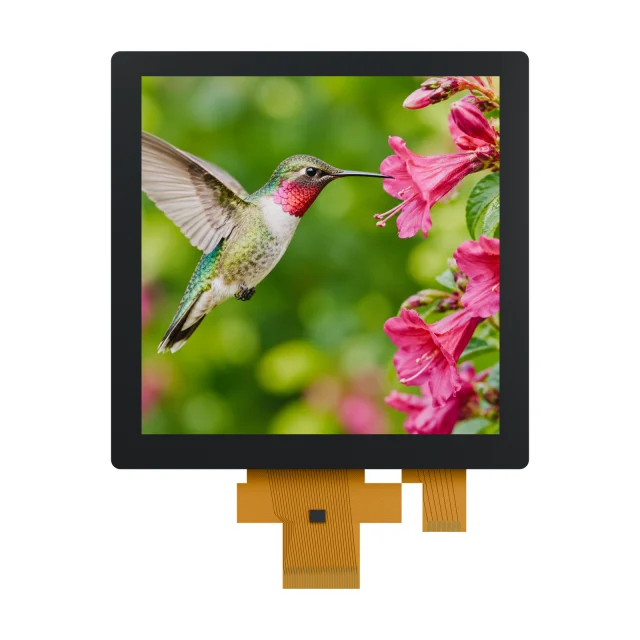
OLED Vs TFT LCD Comparison
| Factor | OLED | TFT LCD |
|---|---|---|
| Light source | Self-emissive pixels | Backlight behind the LCD panel |
| Black level and contrast | True black; very high contrast | Limited by backlight leakage; VA and IPS modes improve it |
| Viewing angle | Very wide | Wide with IPS or VA; narrower with TN |
| Brightness and sunlight | Raising brightness shortens lifetime; small modules are often hard to read in direct sun | Backlight can be specified for high brightness; transflective and optical-bonding options help outdoors |
| Static content and lifetime | Pixels that stay on age faster, so fixed logos and menus can leave burn-in | Backlight brightness decays gradually and evenly; LCD image retention is usually a drive-condition issue |
| Temperature | Fast response in the cold; high temperature accelerates aging | Response slows in the cold unless the LC and drive are specified for it; wide-temperature grades are common |
| Power | Depends on content; dark screens use less | Mostly set by the backlight, regardless of content |
| Size range and supply | Strong in small and phone-class sizes | Very wide range from small modules to large panels, many interfaces |
How To Choose
- Look at the screen content. Static dashboards, logos and status bars favor LCD. Changing, mostly dark UI suits OLED.
- Check the light. Outdoor or bright-room use points to a high-brightness or sunlight-readable TFT, or a transflective LCD, and compare 300, 500 and 1000-nit brightness levels.
- Check temperature. For cold starts, review LCD cold response time and wide-temperature TFT modules.
- Plan the product life. For long-running equipment, compare expected lifetime at your brightness and duty cycle, and plan replacement with the discontinued LCD replacement guide.
- Confirm the interface. Match SPI, RGB, LVDS or MIPI DSI to the host; see the TFT LCD interface guide.
Video: OLED vs TFT LCD
This short SuccessLCD explainer compares how OLED and TFT LCD make light, contrast, sunlight readability, burn-in versus LCD image retention, temperature and lifetime, and how to choose for your product.
OLED Vs TFT LCD FAQs
Is OLED better than TFT LCD?
OLED is better for contrast, black level and thinness. TFT LCD is usually better for high brightness, static content, long service life and wide size and temperature choice. The right choice depends on the screen content, environment and product life.
Do OLED displays burn in?
They can. Pixels that show the same bright content for long periods age faster than others, leaving a visible ghost. Moving or dimming static elements reduces the risk but does not remove it.
Which is better in sunlight, OLED or LCD?
A TFT LCD with a high-brightness backlight, optical bonding or a transflective design is usually easier to read in direct sunlight than a small OLED module.
Can LCD displays get image retention too?
Yes, but the cause is different: LCD image retention usually comes from drive conditions such as DC bias and is often temporary. See TFT LCD image retention.
Does SuccessLCD supply OLED displays?
No. SuccessLCD supplies TFT LCD modules, monochrome LCD and LCM modules, custom segment LCDs, touch panels and cover lenses.
Comparing display options? Browse TFT LCD module references or send your display requirements for an engineering review. If no standard module fits, see custom TFT display engineering.