
Sunlight Readable TFT LCD Displays
Outdoor display readability
Sunlight readable TFT LCD displays help outdoor OEM devices stay readable across glare, shade, touch interaction and enclosure constraints.
RFQ intent check
When sunlight readable is the better starting point
Use this page when the issue is outdoor readability: glare, reflection, touch cover thickness, optical bonding, AG/AR coating or enclosure viewing angle. If the RFQ is mainly about nit value, power and heat, compare the high brightness TFT LCD module guide.
Definition
What is a sunlight readable TFT LCD display?
A sunlight readable TFT LCD display is an active-matrix color display configured for visibility in bright outdoor or high-ambient-light conditions. The design normally combines a suitable brightness target with reflection control, optical bonding, cover glass review, viewing-angle selection, thermal validation and enclosure-level testing.
The keyword “sunlight readable” should be treated as a product performance goal, not a single fixed nit value. A display can be bright but still difficult to read if the front glass reflects the sky, the touch stack creates air-gap reflections, the enclosure angle points into glare, or the backlight creates too much heat for continuous outdoor operation.
System design
Sunlight readability is a system result
Outdoor readability usually depends on several design variables working together. Increasing brightness helps, but a reliable product specification should also include reflection, contrast, bonding, surface treatment, viewing direction, power and heat.
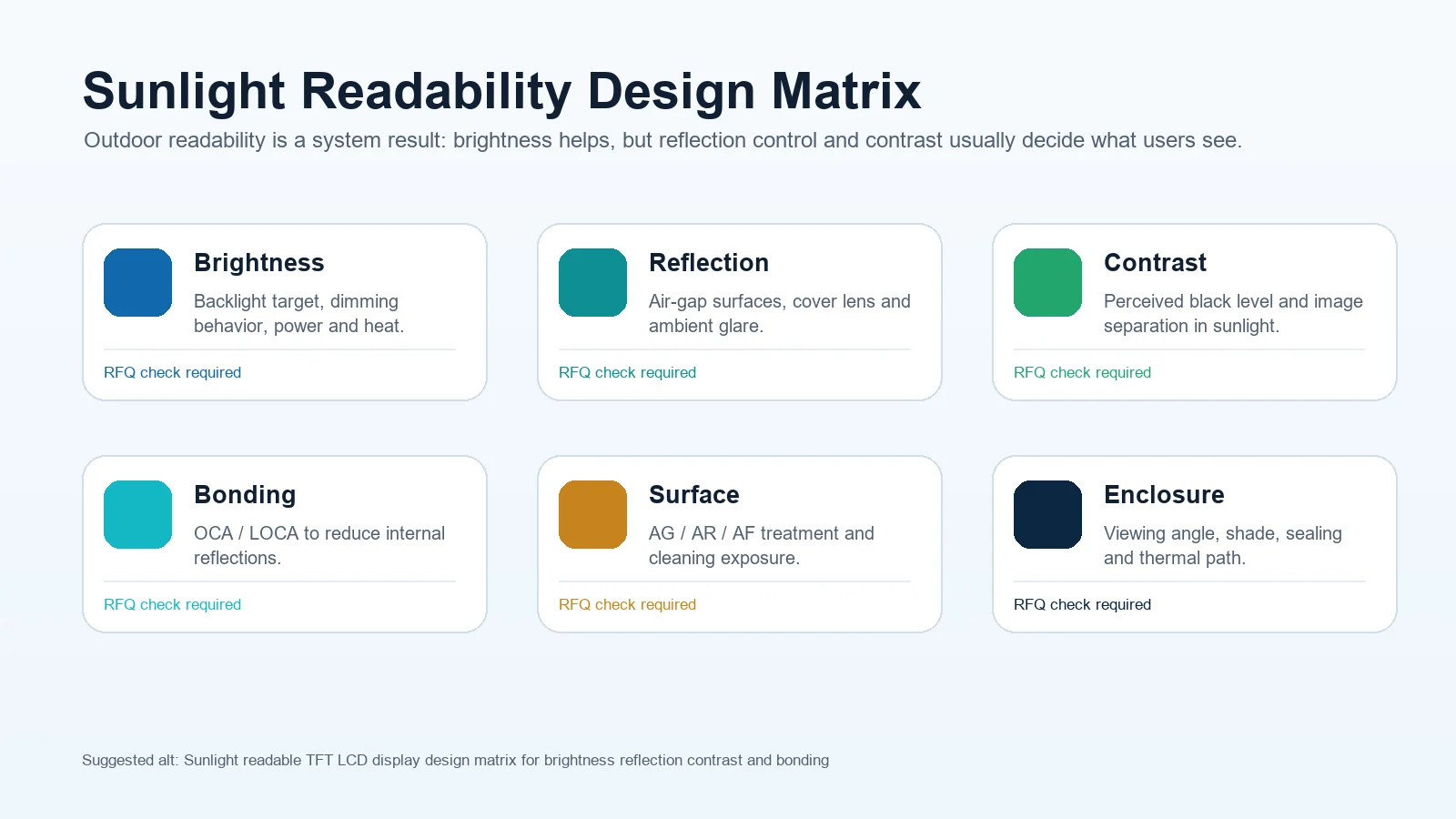
| Design factor | Why it matters | RFQ question to answer |
|---|---|---|
| Brightness target | Higher backlight output can improve visibility, but increases power and heat. | What module-level luminance target is needed: 700-1000 cd/m2, 1000+ cd/m2, or project-specific? |
| Reflection control | Air gaps and glass surfaces can reflect sunlight back to the viewer. | Will the product use cover glass, touch, AG/AR coating or optical bonding? |
| Contrast retention | Readability depends on perceived contrast, not only peak brightness. | Does the UI need text, icons, video, warning colors or fine detail outdoors? |
| Thermal path | Outdoor screens can heat from sunlight and backlight current at the same time. | What is the maximum internal enclosure temperature and duty cycle? |
Brightness vs readability
High brightness and sunlight readability are related, but not identical
High brightness focuses on the backlight and luminance target. Sunlight readability focuses on the full optical and mechanical system that keeps the screen readable outdoors.
| Use condition | Planning direction | Design note |
|---|---|---|
| Indoor or controlled lighting | 250-500 cd/m2 may be sufficient | Reflections are usually easier to control indoors. |
| Bright indoor or semi-outdoor use | 500-700 cd/m2 | Useful for factory floors, near-window devices and portable equipment. |
| Outdoor shade or high ambient light | 700-1000 cd/m2 | Often paired with optical bonding, cover glass review and dimming control. |
| Direct sunlight or harsh outdoor use | 1000+ cd/m2 project target | Requires feasibility review for heat, power, bonding, coating and enclosure design. |
These values are planning language only. Higher or specialized outdoor targets should be confirmed through RFQ, sample evaluation and thermal validation.
Model-level optical reference: COM31H3P76ULC’s Blanview TFT optical profile lists 420 cd/m² minimum / 600 cd/m² typical center brightness at 14 mA and 25 °C, with 700:1 typical contrast under the source method. These laboratory values do not guarantee direct-sunlight readability in a finished product; cover reflections, bonding, backlight drive and system testing still govern.
Optical stack
Optical bonding and front-stack design
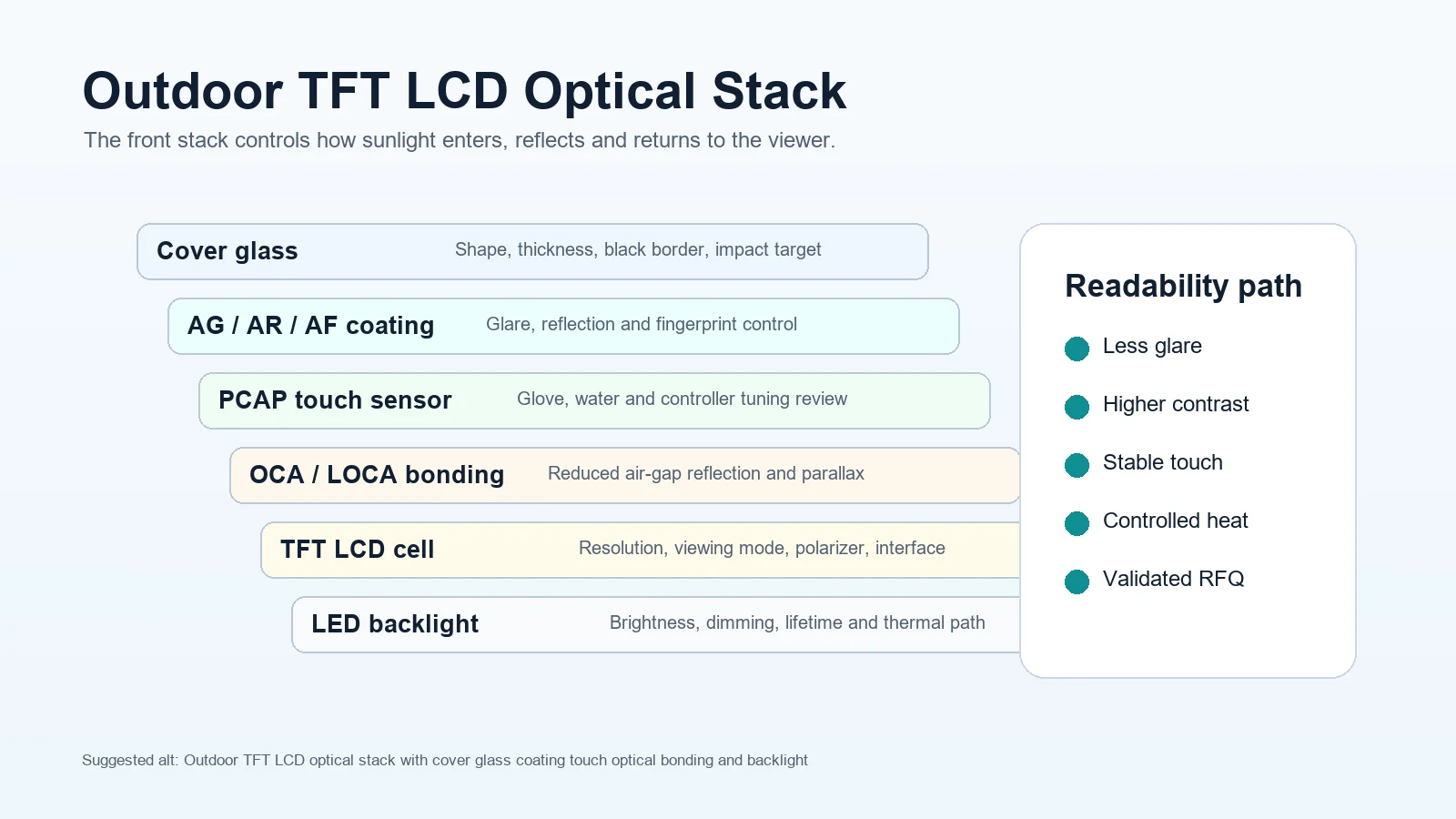
Optical bonding is one of the most important design choices for sunlight readable touch displays. In an air-gap structure, light can reflect at multiple internal surfaces between cover glass, touch sensor and LCD. Under sunlight, those reflections can wash out black levels and reduce readable contrast.
OCA or LOCA bonding fills the air gap with optically clear adhesive, which can reduce internal reflections, lower parallax, improve perceived contrast and reduce condensation risk. For more detail, review optical bonding vs air gap LCD.
Technology options
Choose the outdoor display approach by application
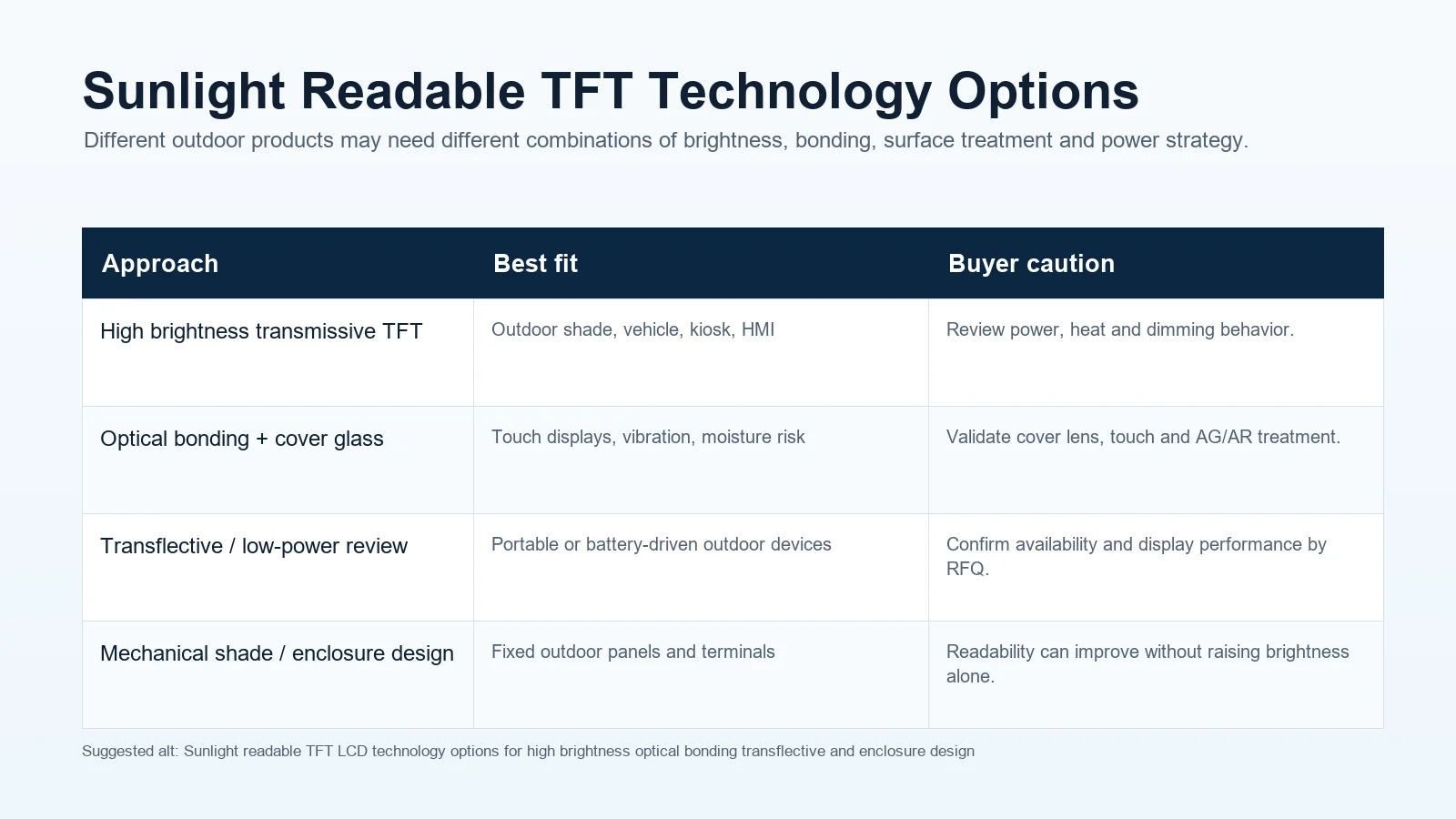
Different outdoor products may need different sunlight-readable display approaches. The right choice depends on brightness, power, runtime, environment, touch stack and expected production lifecycle.
High brightness transmissive TFT, optical bonding, surface treatment, transflective/low-power review and mechanical shade design can all be part of the decision. Treat transflective options as project-specific engineering choices that require RFQ confirmation.
Application fit
Where sunlight readable TFT displays are commonly used
Outdoor payment and charging terminals
Require day/night visibility, touch usability, cover glass review, dimming and thermal protection.
HMI and field equipment
Need readability under overhead light, dust, vibration and long operating hours.
Mobile outdoor systems
Can face reflected sunlight, moisture, vibration and temperature variation.
Portable diagnostic devices
May be used near windows, under bright light or in mobile environments with cleaning exposure.
RFQ checklist
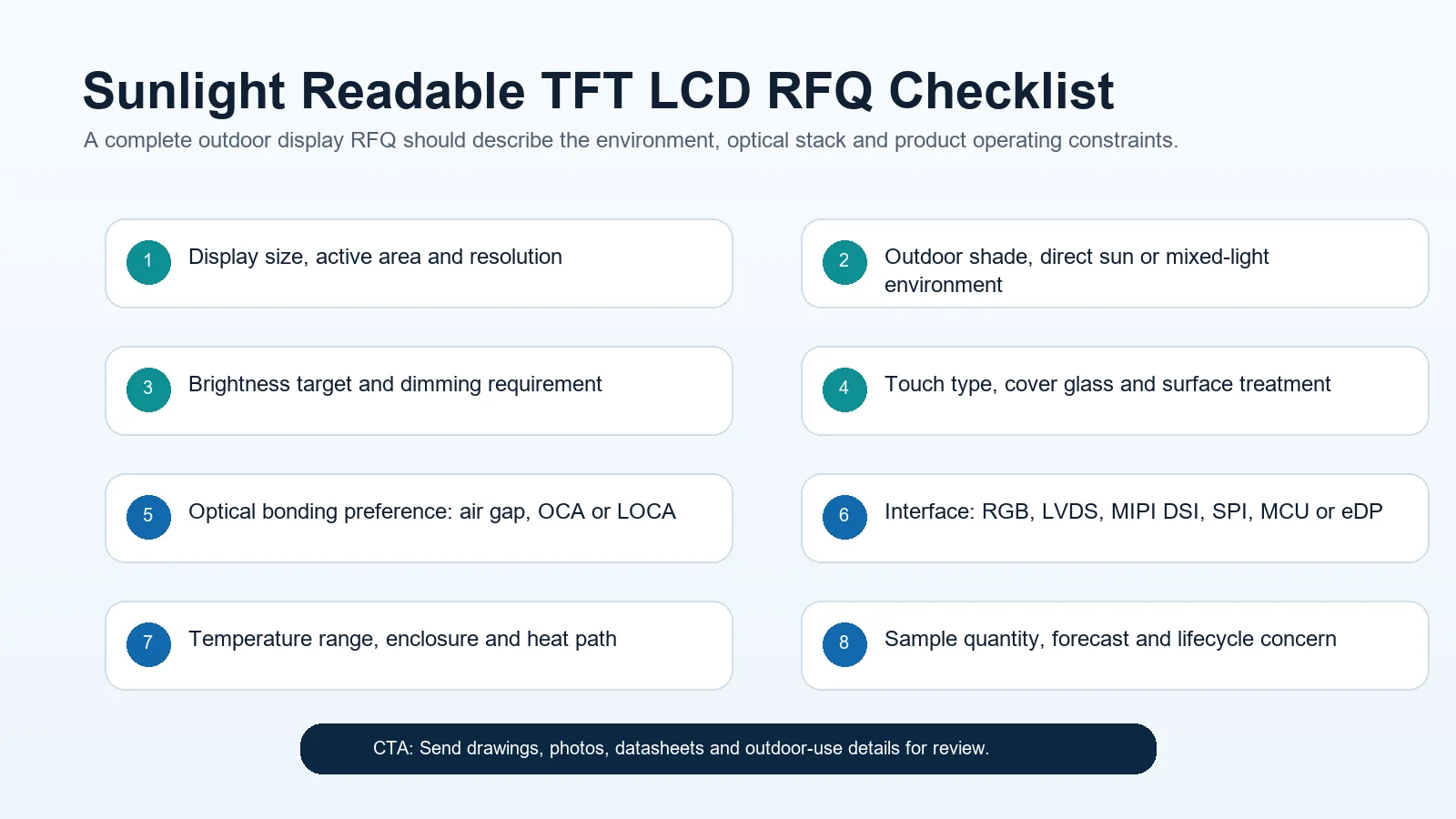
Send these details for a sunlight readable TFT LCD quote
- Display size, active area and resolution
- Outdoor shade, direct sun, vehicle, kiosk or handheld use case
- Brightness target in cd/m2 or nits
- Touch, cover glass and surface treatment
- Optical bonding preference: air gap, OCA or LOCA
- Interface: RGB, LVDS, MIPI DSI, SPI, MCU or eDP
- Temperature range, enclosure and heat path
- Sample quantity, forecast and lifecycle concern
Industrial routing
Connect sunlight readability to the full device environment
Outdoor readability is usually decided together with enclosure angle, HMI duty cycle, touch stack, cover glass and thermal path. For rugged equipment projects, compare the sunlight readable display path with industrial TFT LCD display module requirements, the dedicated wide temperature TFT LCD modules guide and the broader LCD display application map.
Related engineering resources
Related display resources
FAQ
Sunlight readable TFT LCD display questions
Is a sunlight readable TFT LCD display the same as a high brightness TFT?
No. A high brightness TFT focuses mainly on backlight output and luminance, while a sunlight readable TFT LCD display focuses on the complete outdoor readability system: brightness, contrast, reflection control, optical bonding, cover glass, touch stack, surface treatment, viewing angle and thermal design.
What nit level is needed for outdoor TFT LCD displays?
Outdoor shade and high-ambient-light applications often use 700-1000 cd/m2 as early planning language. Direct sunlight applications may require 1000+ cd/m2 targets, but the correct value depends on reflection control, bonding, contrast, enclosure angle, heat and runtime requirements.
Does optical bonding make an LCD sunlight readable?
Optical bonding can significantly improve outdoor readability by reducing internal air-gap reflections and preserving contrast. However, it does not replace brightness, thermal design, cover glass review or enclosure-level validation.
Should I choose AG, AR or AF coating for an outdoor display?
AG treatment diffuses reflected light to reduce distinct glare images; AR coating reduces surface reflection, and AF treatment helps with fingerprints and cleaning. Confirm the optical trade-offs on the finished display stack. The best choice depends on the application, touch requirements, glass material, cleaning exposure and appearance target.
Can a touch screen be sunlight readable?
Yes, but the touch stack must be reviewed carefully. Projected capacitive touch, cover glass thickness, sensor layout, bonding method, coating and controller tuning can all affect sunlight readability and outdoor usability.
What should I send for a quote?
Send display size, resolution, interface, brightness target, use environment, touch requirement, cover glass details, bonding preference, surface treatment, operating temperature, enclosure constraints, dimming behavior, sample quantity and annual forecast.
Next step
Need an outdoor display review?
Send the size, interface, brightness target, touch stack, cover lens, bonding preference and use environment for review.
Outdoor Readability Test Plan for Sunlight Readable TFT LCDs
A sunlight readable TFT LCD should be approved under real device conditions, not only by checking a panel on a desk. Before mass production, review the complete stack: high brightness backlight, cover lens, touch panel, optical bonding, surface treatment, enclosure angle, heat path and dimming behavior.
| Test checkpoint | What to verify | Why it affects sunlight readability |
|---|---|---|
| Ambient light condition | Indoor bright light, shaded outdoor use, direct sunlight angle and reflected glare. | The same display can look acceptable in shade but washed out under direct reflection. |
| Complete front stack | LCD, touch sensor, cover lens, air gap or optical bonding, AG/AR/AF treatment and protective film. | Each layer changes transmission, reflection, contrast and touch visibility. |
| Thermal condition | Backlight current, sealed enclosure heat, sunlight exposure time and working temperature. | Higher brightness increases heat, and heat can affect lifetime, uniformity and reliability. |
| Viewing geometry | Mounting angle, user viewing angle, polarizer orientation and UI contrast. | Outdoor readability depends on where the user stands and how sunlight hits the surface. |
| Night and low-light use | Dimming range, automatic brightness control and minimum comfortable luminance. | A display bright enough for daytime can be uncomfortable or power-hungry at night. |
Good RFQ signals
- The buyer defines the real outdoor condition, not only a target nit value.
- The enclosure drawing shows viewing angle, cover opening and available heat path.
- Touch, cover lens, optical bonding and surface treatment are reviewed together.
- The project defines sample testing method before locking the display stack.
Common failure causes
- Choosing high brightness but leaving an air gap and reflective cover lens untreated.
- Ignoring backlight heat in sealed outdoor housings.
- Testing only the bare LCD instead of the final touch and cover lens assembly.
- Using a UI with low contrast, small text or poor color contrast for outdoor use.
Choose the Right Outdoor LCD Engineering Path
| Project need | Recommended path | Useful next page |
|---|---|---|
| The device mainly needs a brighter backlight. | Start with high brightness TFT module review, then check power and thermal limits. | High brightness TFT LCD modules |
| The display is washed out because of glare or internal reflection. | Review optical bonding, cover lens treatment and air-gap reflection. | Optical bonding vs air gap LCD |
| The display operates in hot, cold or sealed outdoor equipment. | Define wide-temperature needs together with backlight and enclosure heat. | Wide temperature TFT LCD modules |
| The front surface needs touch, cover lens, logo printing or special coating. | Review PCAP/RTP touch, AG/AR/AF, cover lens thickness and bonding method. | Touch panel and cover lens solutions |
Sunlight Readable Display Approval FAQ
Should the sample be tested before or after cover lens assembly?
Test both if possible, but final approval should use the complete front stack. Touch sensors, cover lens thickness, surface treatment, air gap and bonding can all change perceived contrast and glare.
Can optical bonding reduce the brightness requirement?
It can improve perceived readability by reducing internal reflections and preserving contrast, so the project may not need to rely only on stronger backlight output. The final decision still depends on ambient light, enclosure angle, thermal design and user interface contrast.
What should be included in an outdoor LCD sample report?
Include photos or videos under the target light condition, brightness setting, viewing angle, enclosure state, surface treatment, touch response, temperature observation and any readability issues. This helps the engineering team adjust the stack before mass production.
Need a supplier review checklist before RFQ?
Use the 2026 LCD sourcing checklist to review brightness, interface, touch stack, bonding, lifecycle and replacement risk before sample approval or mass production planning.


