
High Brightness TFT LCD Modules
Custom TFT module engineering
High brightness TFT LCD modules support OEM devices that need readable screens in bright indoor, semi-outdoor or outdoor environments.
Definition
What is a high brightness TFT LCD module?
A high brightness TFT LCD module is an active-matrix color LCD assembly designed with a stronger backlight than standard indoor displays. In OEM projects, it is specified together with interface, touch, cover glass, optical bonding, thermal design and lifetime targets so the finished device can stay readable in high ambient light.
Do not select by nit value alone. Readability also depends on polarizer, cover lens, touch sensor, bonding, coating, enclosure angle and heat path.
Brightness planning
When should you choose high brightness?
Choose a high brightness TFT LCD module when the end product needs stable visibility outside normal indoor lighting. Common cases include outdoor handheld devices, industrial panels under overhead lighting, vehicle or mobility displays, public charging interfaces, agricultural equipment, marine instruments and portable medical systems.
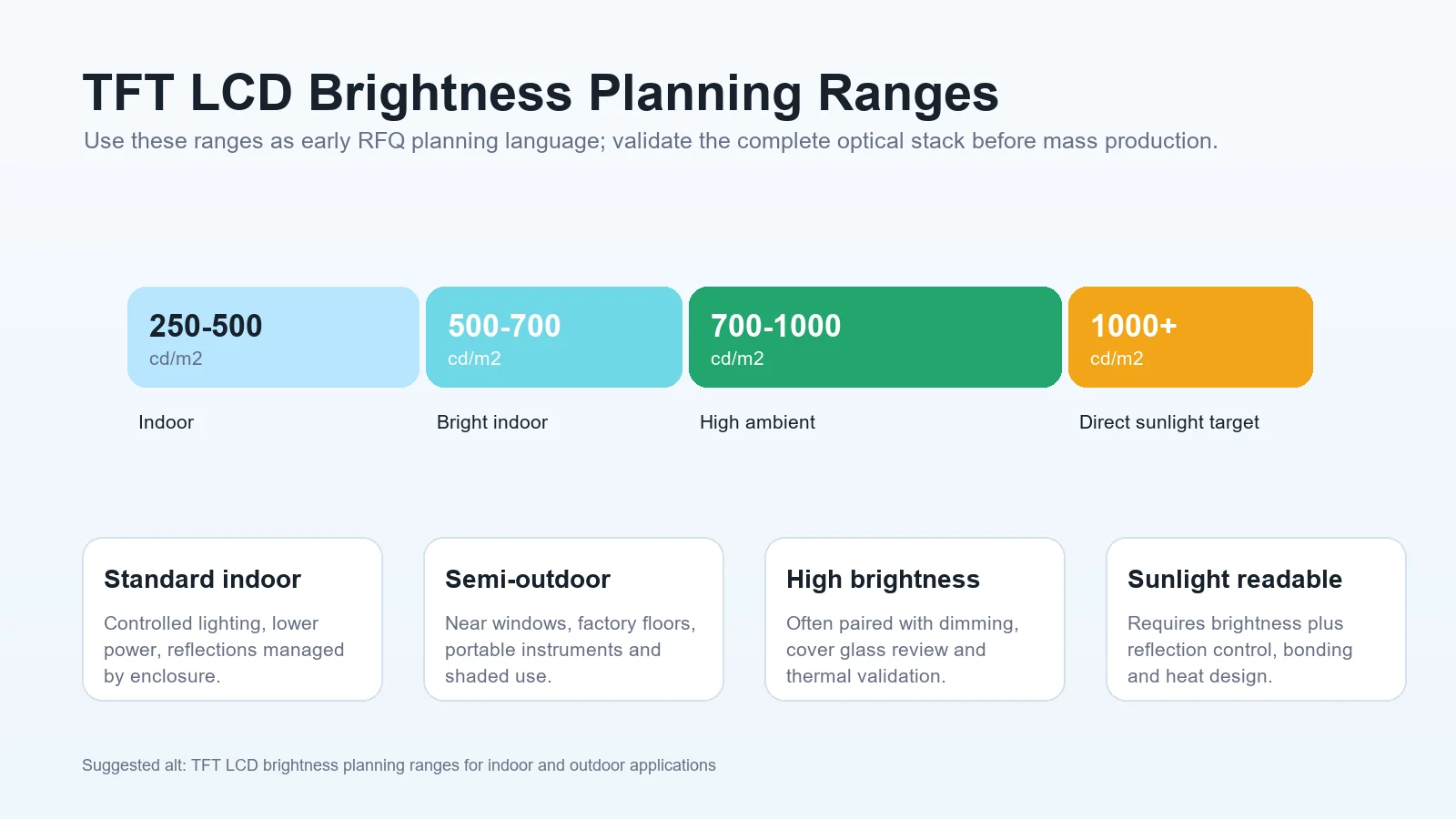
| Use environment | Common planning brightness | Design notes |
|---|---|---|
| Controlled indoor equipment | 250-500 cd/m2 | Standard TFT brightness may be sufficient if reflections are controlled. |
| Bright indoor or semi-outdoor use | 500-700 cd/m2 | Useful for factory floors, near-window equipment and portable instruments. |
| High ambient light or outdoor shade | 700-1000 cd/m2 | Often paired with wide viewing angle, cover glass review and dimming control. |
| Direct sunlight or harsh outdoor use | 1000+ cd/m2 project target | Requires feasibility review for power, heat, optical bonding, coatings and enclosure design. |
These are planning values, not a finished product guarantee. For a target around 1000 cd/m2, request a model- or stack-specific specification with the backlight current, temperature, continuous-duty conditions and controlled revision before design approval. Higher or specialized targets should be confirmed through project RFQ, sample evaluation and thermal validation.
Engineering trade-offs
What buyers should review before locking the display
Brightness, power and heat
Increasing LED backlight output raises power consumption and heat. Review battery life, enclosure temperature, LED stress and dimming behavior before selecting the highest nit value.
Reflection control
Air gaps can wash out contrast under high ambient light. Optical bonding can reduce internal reflections and improve perceived readability.
Touch and cover glass
Cover glass thickness, black border printing, glove use, water interference and AG/AR/AF coating can all affect the final user experience.
Interface matching
Confirm RGB, LVDS, MIPI DSI, MCU, SPI or eDP requirements before changing size, resolution or host processor architecture.
Buyer intent check
High brightness vs sunlight readable TFT LCD
Use this high brightness guide when the RFQ is about nit target, backlight current, dimming, power, heat and LED lifetime. Use the sunlight readable TFT LCD display guide when the real issue is outdoor glare, reflection, cover glass, touch stack, optical bonding, AG/AR coating or enclosure angle.
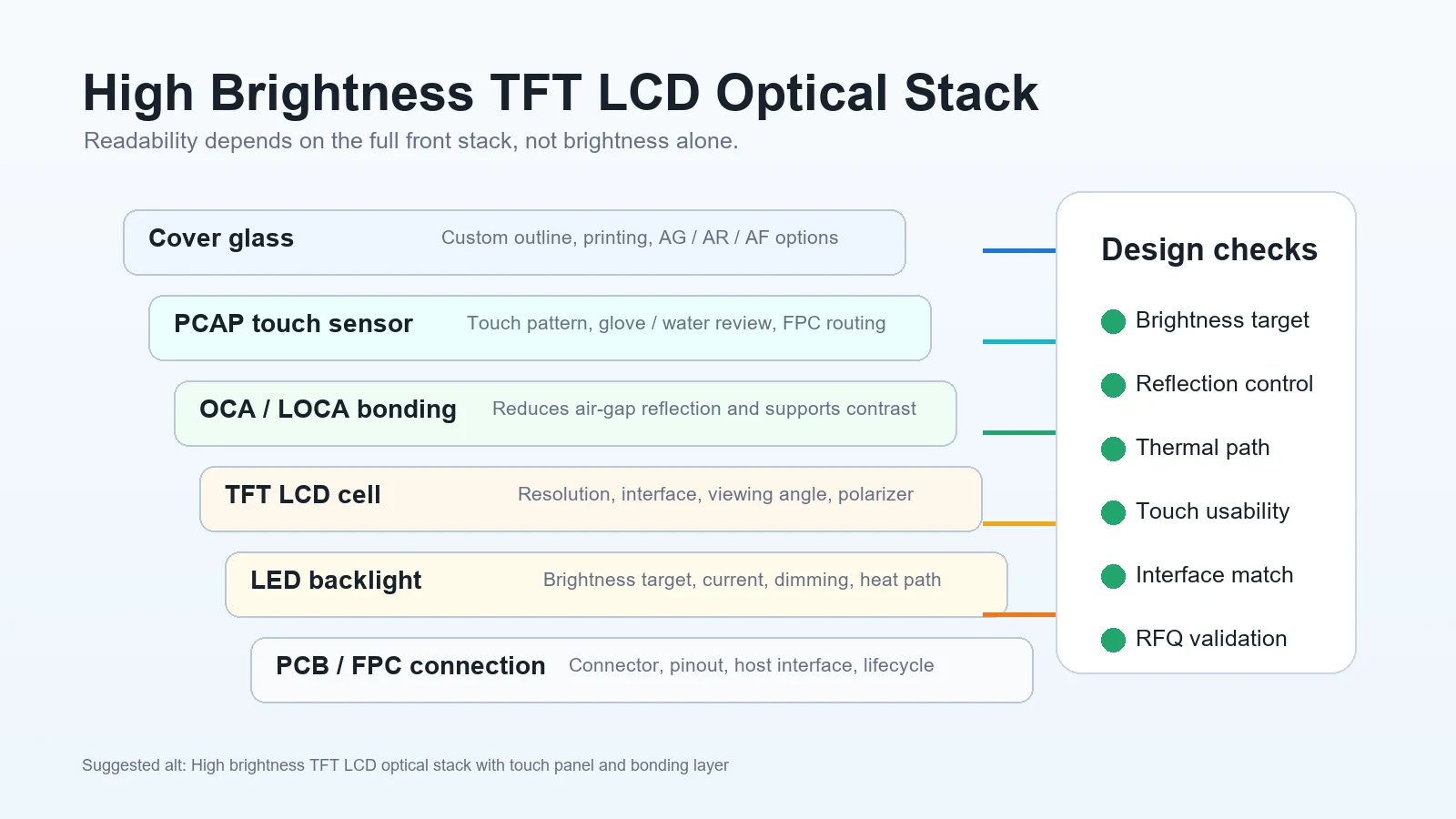
Optical stack
High brightness works best with reflection control
High brightness alone does not solve every readability problem. Air gaps between the cover lens, touch panel and LCD create internal reflection surfaces. In high ambient light, those reflections can wash out contrast even if the backlight is strong.
Optical bonding fills the air gap with optically clear adhesive, such as OCA or LOCA, to reduce internal reflections, improve perceived contrast, reduce parallax and lower condensation risk. For harsh environments, compare the design options in optical bonding vs air gap LCD.
Customization scope
Specify the module as a system, not just a brighter backlight
| Specification area | Options to define |
|---|---|
| Display size | 0.96 inch to 15.6 inch TFT module families, subject to project availability. |
| Resolution and interface | Standard or project-matched resolution with SPI, MCU, RGB, LVDS, MIPI DSI, eDP or other feasible host interface. |
| Luminance and viewing mode | Indoor brightness up to high brightness targets, with IPS wide-view or suitable TN panel logic where applicable. |
| Touch and cover lens | No touch, resistive touch, projected capacitive touch, custom outline, printed border and surface treatment. |
| Bonding and backlight | Air gap bonding, OCA optical bonding, LOCA optical bonding, LED current, voltage, dimming and lifetime review. |
| Operating environment | Indoor, semi-outdoor, outdoor, wide-temperature, vibration-prone or lifecycle-sensitive use. |
Applications
Where high brightness TFT modules are commonly used
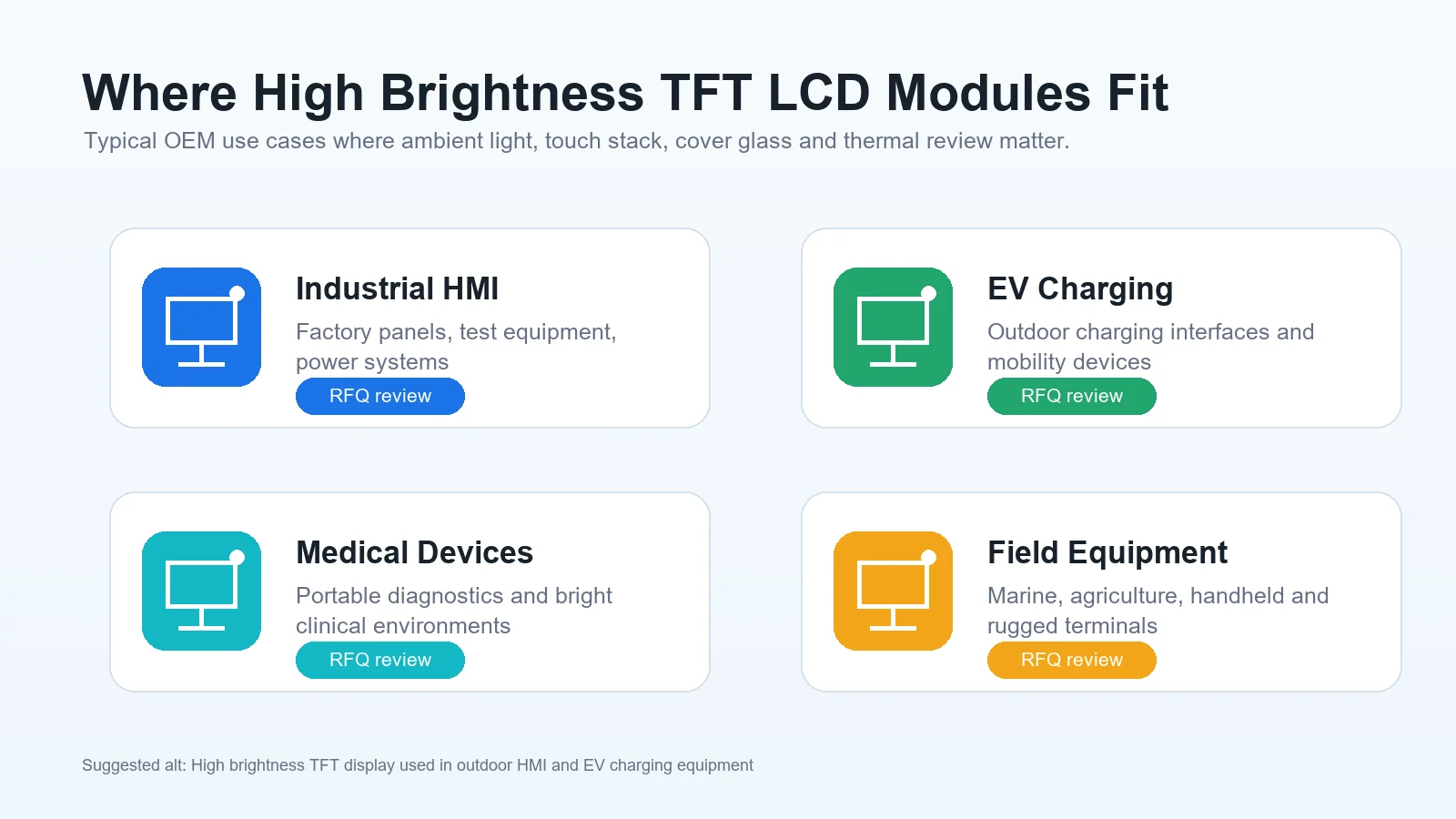
Industrial control panels, EV chargers, vehicle accessory displays, public kiosks, portable medical instruments, marine devices and agricultural controls can all face strong light, moisture, vibration or temperature swings.
For these programs, pair high brightness with wide-temperature review, bonding, sealing strategy and mechanical protection.
RFQ checklist
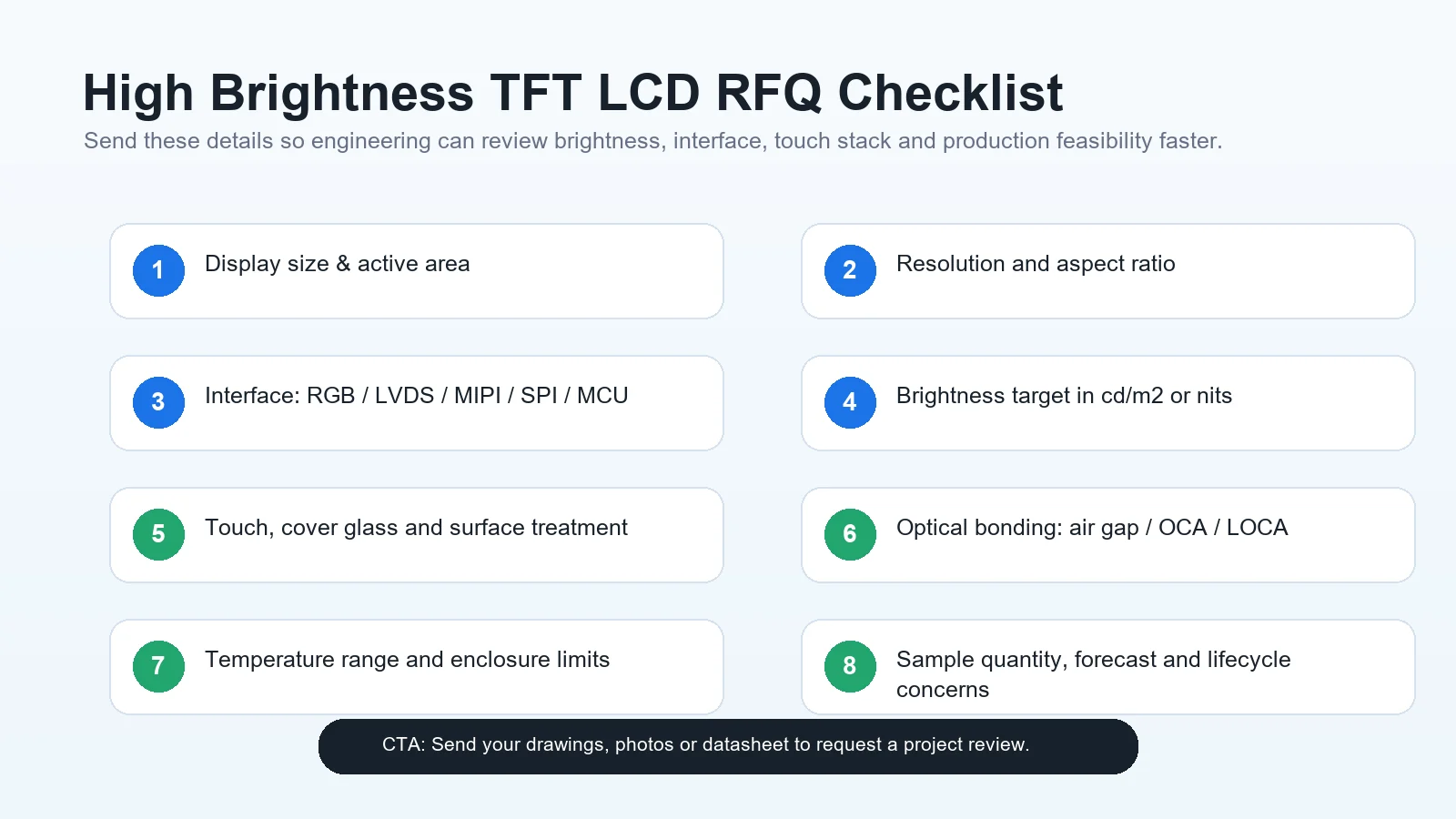
Send these details for a high brightness TFT LCD quote
- Display size and target active area
- Resolution and preferred aspect ratio
- Interface: RGB, LVDS, MIPI DSI, SPI, MCU or eDP
- Brightness target in cd/m2 or nits
- Indoor, semi-outdoor, outdoor shade or direct-sunlight use case
- Touch requirement and cover glass details
- Optical bonding preference: air gap, OCA or LOCA
- Operating temperature, enclosure constraints and forecast
Related engineering resources
Related display resources
FAQ
High brightness TFT LCD module questions
What brightness is considered high brightness for a TFT LCD module?
For many OEM projects, 700 cd/m2 and above is treated as high brightness compared with typical indoor TFT displays. Outdoor or direct-sunlight applications may require 1000 cd/m2 or higher, but the final target should be validated with the complete optical stack and enclosure.
Is a high brightness TFT LCD module the same as a sunlight readable display?
Not always. A high brightness TFT LCD module has stronger backlight output, while a sunlight readable display also depends on contrast, reflection control, optical bonding, cover glass treatment, viewing angle and thermal design.
Does optical bonding improve outdoor readability?
Yes. Optical bonding can improve outdoor readability by reducing internal air-gap reflections and preserving contrast. It can also reduce parallax and condensation risk in touch display assemblies.
What are the main disadvantages of high brightness TFT LCD modules?
The main trade-offs are higher power consumption, more heat, possible LED lifetime impact, thicker backlight structure and higher module cost. These risks can be managed by choosing the right brightness target, using dimming control and validating thermal performance in the enclosure.
Can SuccessLCD customize the touch panel and cover glass?
Yes. SuccessLCD can review no-touch, resistive touch and projected capacitive touch options together with custom cover glass, printed border, AG/AR/AF surface treatment and OCA or LOCA optical bonding. Final feasibility depends on display size, stack thickness, mechanical constraints and order requirements.
What information should I send for a quote?
Send the display size, resolution, interface, brightness target, operating environment, touch requirement, cover glass details, optical bonding preference, temperature range, enclosure constraints, sample quantity and annual forecast.
Next step
Need a high brightness display review?
Send the target size, interface, brightness range, touch stack, cover lens, bonding preference and use environment for review.
Need a supplier review checklist before RFQ?
Use the 2026 LCD sourcing checklist to review brightness, interface, touch stack, bonding, lifecycle and replacement risk before sample approval or mass production planning.


