
LCD Controller And Driver ICs: Segment, Character, Graphic And TFT Guide
Quick answer: every LCD needs a driver that generates the voltages on its electrodes, and most modules also include a controller that stores the image and talks to your microcontroller. Segment LCDs use a microcontroller’s built-in LCD controller or a segment driver such as an HT1621-class 32 × 4 device. Character LCDs use HD44780-compatible controllers. Monochrome graphic LCDs use controllers such as ST7565, ST7567, UC1701, ST7920 or KS0108. Small TFTs use driver ICs with built-in frame memory such as ST7735, ILI9341, ST7789 and ILI9488, while larger TFTs are driven through RGB, LVDS or MIPI interfaces.
The driver IC decides the interface, the initialisation code and often the resolution, so it is one of the first things to confirm on a module drawing. SuccessLCD states the interface and, where relevant, the driver IC for each module project; for example the 3.5-inch S35001D TFT lists a 24-bit RGB interface with SPI and an ST7272A driver.
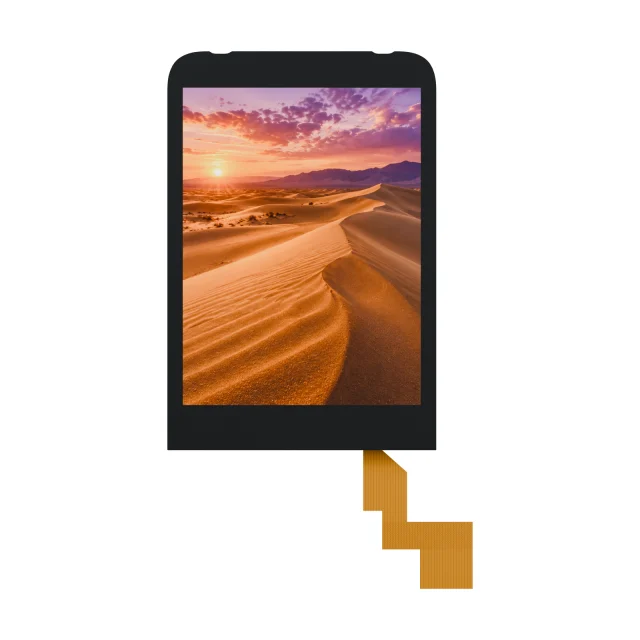
Controller Vs Driver
- Driver: produces the row and column (COM and SEG, or gate and source) voltages that switch the liquid crystal. Every LCD has one, either as a separate chip, bonded on the glass (chip-on-glass) or inside a microcontroller.
- Controller: holds display memory, accepts commands over an interface such as SPI, I2C or a parallel bus, and refreshes the driver continuously. Many small-display ICs combine controller and driver in one chip.
How the IC is mounted (COB, COG or on the panel) is explained in what is an LCD module and COG LCD display.
Segment LCD Drivers
| Option | Typical capacity | Interface | Notes |
|---|---|---|---|
| Microcontroller with LCD controller | Depends on the MCU; commonly up to 4 or 8 COMs | Internal | Lowest part count and power; glass designed around the MCU’s COM/SEG pins and bias options |
| HT1621-class driver | 32 SEG × 4 COM (128 segments) | Simple serial (CS, WR, DATA) | Widely used for 1/2 to 1/4 duty glass |
| HT1622-class driver | 32 SEG × 8 COM (256 segments) | Simple serial | For 1/8 duty glass with more icons |
| PCF8576-class driver | 40 SEG × 4 COM (160 segments) | I2C | Cascadable for larger displays |
| Chip-on-glass segment module | Set by the bonded IC | Usually SPI or I2C | Driver bonded on the glass, connected by FPC; e.g. S2947D segment COG LCD |
The glass and driver must agree on duty, bias and voltage; see segment LCD duty and bias.
Character LCD Controllers
Character modules such as 16 × 2 and 20 × 4 are built around the HD44780 instruction set or compatible controllers (for example ST7066U-type parts). They contain a character generator ROM with a 5 × 8 dot font, room for eight user-defined characters and a 6800-style parallel interface that can run in 8-bit or 4-bit mode. I2C or SPI versions add an interface chip or use a controller with a serial port. See the character LCD module guide; our S4132D 20 × 4 STN character glass is specified at 1/16 duty, 1/5 bias.
Monochrome Graphic LCD Controllers
| Controller family | Typical matrix | Interface | Notes |
|---|---|---|---|
| ST7565 / ST7567 / UC1701-type | Up to 65 × 132 dots | 8080/6800 parallel or SPI | Common in chip-on-glass 128 × 64 modules; low power, built-in voltage generation |
| ST7920-type | Often 128 × 64 | Parallel or serial | Built-in Chinese and alphanumeric fonts plus graphic mode |
| KS0108-type | 64 × 64 per chip (two chips for 128 × 64) | Parallel only | Classic COB design, simple to drive, many pins |
| ST75256-class and similar | Larger monochrome matrices | Parallel, SPI or I2C depending on the part | Used where more pixels or grey levels are needed |
See graphic LCD display modules; examples in our catalogue include the S12864D 128 × 64 COB module with a 20-pin header and the S2983D dot-matrix COG FSTN at 1/64 duty. Note that SSD1306 and SSD1309 controllers, which often appear in the same searches, are OLED controllers, not LCD controllers.
TFT Driver ICs
| Driver IC | Typical resolution | Interfaces | Typical panel |
|---|---|---|---|
| ST7735-type | 128 × 160 | SPI, MCU parallel | 1.44- to 1.8-inch TFTs |
| ST7789-type | Up to 240 × 320; often used for 240 × 240 | SPI, MCU parallel, RGB | 1.3- to 2.8-inch TFTs, including round panels |
| ILI9341-type | 240 × 320 | SPI, MCU parallel, RGB | 2.4- to 3.2-inch TFTs |
| ILI9488-type | 320 × 480 | SPI, MCU parallel, RGB | 3.5-inch HVGA TFTs |
| ST7272A-type | 320 × 240 | RGB with SPI set-up | 3.5-inch QVGA TFTs, such as S35001D |
| Panels with RGB, LVDS or MIPI input | 480 × 272 and up | Video interface from the host | 4.3-inch and larger TFTs; see the TFT interface guide |
ICs with built-in frame memory (GRAM) let a microcontroller update only part of the screen over SPI or a parallel bus. Panels without frame memory need a continuous video stream from a processor with a display controller. Bandwidth trade-offs are worked through in I2C vs SPI vs UART vs parallel and compared by size in the small TFT LCD display comparison.
What To Check On A Module Drawing
- Driver IC and interface: exact part and the interface modes brought out on the FPC or pins.
- Initialisation sequence: confirm that a working sequence for this panel and IC is available, including gamma and power settings for TFTs.
- Logic and LCD supply voltages: some ICs generate the LCD voltages internally; others need external supplies.
- Orientation and scan direction: make sure the IC can scan in the direction your mechanical design needs.
- Lifecycle: a change of driver IC can change the initialisation code even when the glass looks identical; see LCD replacement compatibility testing.
LCD Driver IC FAQs
What is the difference between an LCD controller and an LCD driver?
A driver produces the voltages on the LCD electrodes. A controller stores the image, accepts commands from the host and refreshes the driver. Many small-display ICs combine both functions in one chip.
Which IC is used to drive a segment LCD?
Often a microcontroller with a built-in LCD controller, or a dedicated segment driver such as an HT1621-class 32 × 4 device, an HT1622-class 32 × 8 device or a PCF8576-class 40 × 4 I2C device.
What controller do 16 × 2 character LCDs use?
Most use the HD44780 instruction set or a compatible controller, with a 5 × 8 dot font and a 4-bit or 8-bit parallel interface. Serial versions add an I2C or SPI interface.
What is the difference between ILI9341 and ST7789?
Both are TFT driver ICs with built-in frame memory and SPI, parallel and RGB interfaces. ILI9341 is typically used for 240 × 320 panels around 2.4 to 3.2 inches; ST7789 supports up to 240 × 320 and is common on smaller square and round 240 × 240 panels. Their command sets and initialisation sequences differ.
Are SSD1306 and SSD1309 LCD controllers?
No. They are controllers for monochrome OLED displays. They are often mentioned alongside 128 × 64 LCD controllers such as ST7565 because the resolution is similar.
Need a module that works with your existing driver or code? Send the driver IC or controller you use, the interface, resolution and supply voltages. Send your display requirements for an engineering review, or browse TFT LCD modules and monochrome LCD modules. For a module built around your driver IC, see custom LCD modules.