
VA Vs IPS Display: Contrast, Viewing Angle And Where VA LCDs Fit
Quick answer: VA (vertical alignment) and IPS (in-plane switching) are both liquid crystal modes used in LCDs. VA blocks light very well when a pixel is off, so it gives deeper blacks and higher contrast, especially in a dark room. IPS rotates the liquid crystal in the plane of the glass, so colors and brightness stay more consistent when the screen is viewed from the side. Choose VA when black level and contrast matter most; choose IPS when people view the screen from several angles or color consistency matters most.
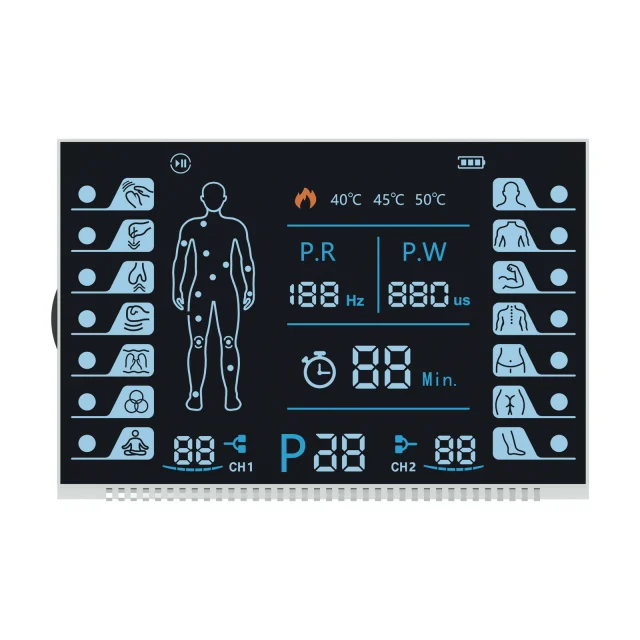
VA is not only a monitor technology. SuccessLCD supplies VA segment LCDs in negative mode, where lit icons and digits appear on a true black background, as well as a VA normally-black round TFT.
How VA And IPS Work
Every transmissive LCD sits between two polarizers. The liquid crystal mode decides how light passes when a pixel or segment is switched:
- VA: with no voltage, the liquid crystal molecules stand perpendicular to the glass, and light is blocked between crossed polarizers. The display is therefore normally black. Voltage tilts the molecules and lets light through.
- IPS: the molecules lie parallel to the glass, and the electric field rotates them within that plane. Because they never tilt toward the viewer, the image changes less with viewing angle.
- TN: the molecules twist between the two glass plates and untwist under voltage. TN is simple and widely used but shows more contrast and color change with viewing direction. See TN vs IPS LCD displays.
VA Vs IPS Vs TN Compared
| Point | VA | IPS | TN |
|---|---|---|---|
| Black level and contrast | Deepest blacks and highest native contrast of the three | Good; blacks look lighter than VA in a dark room | Lowest of the three |
| Viewing angle | Wide, but contrast and color can shift at steep angles | Widest and most consistent | Narrowest; image can invert from some directions |
| Color consistency | Good straight on; gamma and color shift off axis | Best across angles | Limited off axis |
| Typical uses | High-contrast TFTs, monitors, negative segment LCDs with black backgrounds | HMIs, medical and handheld TFTs viewed from several angles | Cost-sensitive TFTs and many positive segment LCDs |
For TFT modules, the panel’s datasheet viewing-angle and contrast figures, measured at stated conditions, are what should be compared. The words VA or IPS alone do not guarantee a specific result. For the difference between IPS and TFT terminology, see IPS vs TFT display.
VA In Segment LCDs: Bright Icons On True Black
In a segment LCD, a VA cell in negative mode keeps the background dark and lets backlight through only the active segments. The result is a light-on-black look with strong contrast, often combined with a white or colored backlight. Points to plan for:
- A backlight is required. A transmissive negative display is dark without it, so power and backlight design are part of the display choice. See the LCD backlight module guide.
- Bright ambient light. In direct sunlight a transmissive negative display can wash out; positive-mode or transflective LCDs are often easier to read outdoors.
- Viewing direction. Confirm the main viewing direction early so the cell, polarizers and artwork are optimized for how the product is used.
- Other negative modes exist. TN, STN and HTN glass can also be built in negative mode, for example the S1982D TN negative transmissive radio display and the S3131D blue negative STN elevator display.
Choosing VA Or IPS For An OEM Product
- Where are users standing? If the display is read from several sides or from above and below, IPS usually holds the image better.
- How dark is the room? In dim rooms, bedside or night use, VA’s deeper black is easier on the eyes and looks more premium.
- Is the content mostly icons and digits? A VA negative segment LCD can give a high-contrast look at lower cost than a full TFT.
- How bright is the environment? For bright rooms or outdoors, review brightness and reflections together; see LCD brightness in nits.
- Temperature range. Liquid crystal response slows in the cold whatever the mode; check the LCD cold response time guide for low-temperature products.
Video: VA vs IPS On Real LCD Samples
This short SuccessLCD explainer shows how VA, IPS and TN switch light, compares contrast and viewing angle, and shows VA negative-mode segment LCDs and an IPS-type TFT as real samples.
SuccessLCD VA Catalogue Examples
| Reference | Display | Notes |
|---|---|---|
| S1386D | VA negative-mode segment LCD for massage devices | 63.00 × 99.00 mm outline, 56 × 96 mm minimum viewing area, 19 rearward pins |
| S2238D | Compact VA negative-mode segment LCD | 26.40 × 25.20 mm outline; battery, timer, dot-pattern characters and Bluetooth icons; FPC with 23 contacts |
| S2287D | Calendar LCD with two rows of three large digits | Negative transmissive optical mode, 37.00 × 45.00 mm minimum viewing area |
| S4842D | VA LCD for pulse oximeters | Zebra connection |
| S4852D | VA LCD for massage devices | Pin connection |
| COM31H3P76ULC | 3.1-inch, 480 × 480 round TFT | VA normally-black a-Si TFT; source specification marked tentative |
Optical mode, backlight color and viewing direction are confirmed for each project. Browse custom segment LCDs or round TFT LCD displays for related options.
VA Vs IPS FAQs
Is VA better than IPS?
Neither is better in every case. VA gives deeper blacks and higher contrast, which suits dark rooms and black-background designs. IPS keeps color and brightness more consistent at wide viewing angles, which suits screens viewed from several positions.
What does normally black mean?
A normally-black LCD blocks light when no voltage is applied, so unpowered pixels or the background look black. VA displays are normally black, which is one reason they show deep blacks; IPS panels are also commonly designed as normally black.
Is a VA LCD the same as a negative LCD?
No. Negative mode describes the look, with light segments on a dark background. VA is one liquid crystal mode often used for negative displays because its background is very dark, but TN, STN and HTN glass can also be made in negative mode.
Are VA displays good outdoors?
A transmissive VA negative display relies on its backlight and can wash out in direct sunlight. For outdoor products, positive-mode or transflective LCDs, higher brightness and reflection control are usually reviewed first.
Why does a VA screen look different from the side?
In VA cells the molecules tilt toward the viewer as they switch, so contrast, gamma and color can shift at steep viewing angles. IPS molecules rotate in the plane of the glass, which keeps the image more consistent off axis.
Choosing between VA, IPS and TN for a product? Send the viewing positions, ambient light, content and enclosure details. See what to include in a TFT LCD module RFQ or send your display requirements for an engineering review, or browse the TFT LCD module catalogue. For a custom viewing direction or brightness target, see custom TFT display engineering.