
TN vs IPS LCD Displays: Which Is Better for OEM Products?
For color active-matrix OEM displays, TN and IPS are liquid-crystal operating modes commonly used in TFT LCD modules. TN can be a practical choice for fixed-view, cost-sensitive products with simple interfaces. IPS is usually the stronger choice when operators must read the display from different directions or when color and contrast need to remain stable across viewing angles. Neither mode is universally better: the correct decision must be verified against the exact module, temperature range, optical stack, touch construction and product lifecycle.
- Consider TN for a controlled viewing direction, a simple status interface and a tightly managed cost target.
- Consider IPS for multi-angle industrial HMIs, portrait or rotated installation, touch-heavy operation, and more stable perceived color.
- Do not select by panel mode alone. Compare the actual module datasheet and validate samples in the final enclosure.
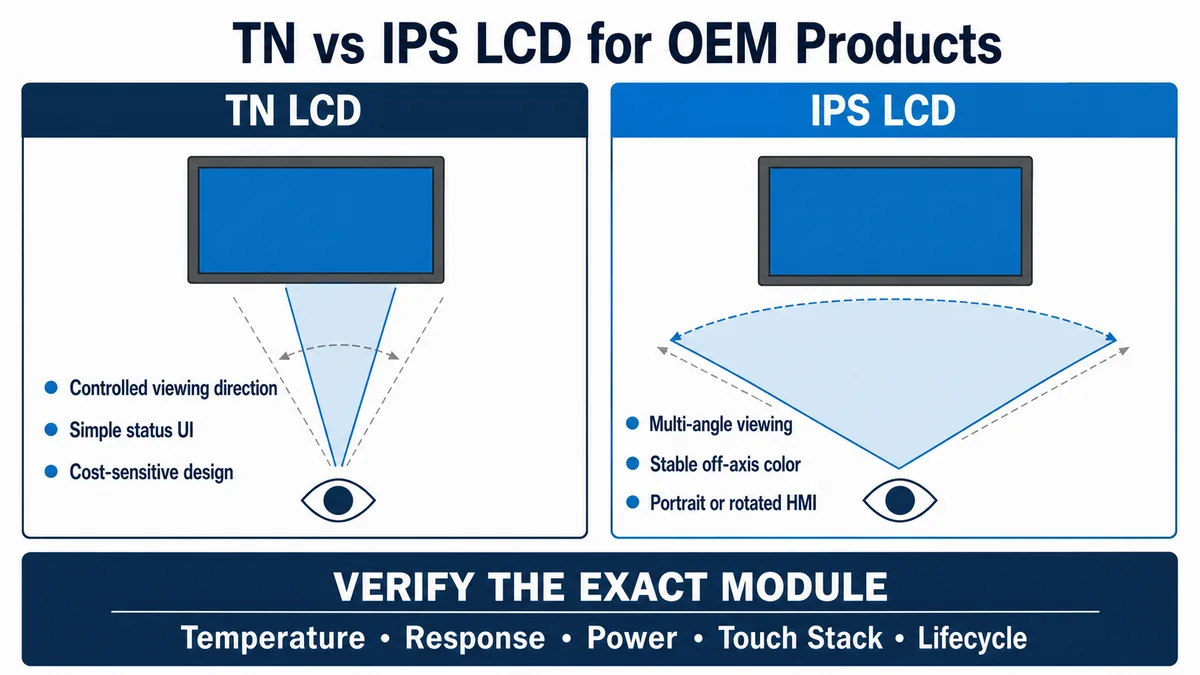
TN vs IPS LCD: quick engineering comparison
The table below describes common design tendencies, not guaranteed specifications. Panel design, liquid-crystal material, polarizers, backlight, driving conditions and compensation methods can change the result. Use it to shortlist a technology, then compare candidate modules under the same test conditions.
| Decision factor | TN tendency | IPS tendency | What the OEM should verify |
|---|---|---|---|
| Viewing angle | More dependent on the specified viewing direction; contrast inversion may appear sooner from an unfavorable angle. | Usually maintains more consistent contrast and color across wider viewing directions. | Required operator positions, portrait or landscape orientation, and the datasheet’s viewing-angle measurement method. |
| Color and grayscale stability | Can shift more noticeably as the viewing direction changes. | Usually more stable for graphics, images and color-coded controls when viewed off-axis. IPS does not by itself guarantee a wider color gamut. | Approved UI screens on physical samples, plus the backlight, color-filter and drive specifications. |
| Response and motion | Some TN designs provide fast transitions, but one response-time value does not describe every black-white or gray-to-gray transition. | Modern IPS modules can also achieve suitable response, depending on cell design and drive method. | Transition behavior measured with the same definition and drive conditions at the product’s minimum, room and maximum operating temperatures. |
| Cost | Often considered when cost and a controlled viewing direction are priorities. | May carry a higher module cost when wider viewing performance is required. | Total qualified cost, including touch, bonding, backlight, tooling, yield and lifecycle risk. |
| Power | Panel mode alone does not determine total module power. Backlight brightness, LED efficiency, duty cycle, interface and touch electronics can dominate. | Backlight and logic current at defined brightness, content and ambient conditions. | |
| Temperature | Both modes are available in industrial-temperature designs, but neither label guarantees a temperature range. Liquid-crystal material, compensation and drive settings are module-specific. | Operating and storage limits, cold-start behavior, response at low temperature and image quality after thermal cycling. | |
| Touch and optical stack | Both can be integrated with resistive or projected-capacitive touch, cover lenses and optical bonding when the module and stack are engineered accordingly. | Optical loss, reflections, touch performance, mechanical tolerance and environmental sealing in the finished assembly. | |
| Supply lifecycle | Lifecycle depends on the exact module and supplier program, not on TN or IPS terminology. | Product status, change-notification policy, last-time-buy support and a replacement strategy. | |
What TN and IPS actually mean
TN: twisted nematic
In a TN cell, the liquid-crystal orientation changes with the applied electric field and modulates light through the polarizers. The construction is widely used and can be effective when the display is viewed mainly from a defined direction. Passive-matrix TN displays also exist, so an OEM should confirm whether the quoted product is an active-matrix TFT module. The important point is not simply that a panel is labeled TN, but whether its preferred viewing direction, contrast behavior and temperature response fit the installation.
IPS: in-plane switching
In an IPS cell, the electric field is arranged mainly within the plane of the substrates. This design generally improves viewing-angle consistency and reduces visible color and contrast changes as the observer moves around the display. It is often suitable for industrial controls shared by several operators, portrait installations and interfaces that rely on color-coded information.
How to choose TN or IPS for an OEM product
1. Define the real viewing geometry
Record who reads the display, the viewing distance, the vertical and horizontal angles, and whether the product can be mounted in more than one orientation. A fixed front-facing instrument may not need the same angle performance as a wall-mounted HMI or bedside device viewed by several people.
2. Test the actual user interface
Simple numerical status information can tolerate different optical behavior than grayscale images, detailed trends or color-coded alarms. Load representative screens onto a candidate module and inspect them from the required directions. Do not approve a panel using a vendor demo pattern alone.
3. Verify performance across temperature
Response time and optical appearance can change with temperature. If the product operates outdoors, in vehicles, cold storage or unconditioned industrial areas, evaluate a qualified wide-temperature TFT LCD module and test cold start, transitions and recovery at the specified limits.
4. Evaluate the complete front stack
A touch sensor, cover lens, air gap, optical adhesive and surface treatment can change reflections, luminance and perceived contrast. Define the required touch-panel and cover-lens integration before approving the LCD rather than treating it as a later mechanical accessory.
For high-ambient-light products, panel mode alone is not enough. Compare luminance, surface reflectance, anti-reflection treatment and optical bonding versus an air gap in the intended enclosure.
5. Compare the complete qualified module
Request model-specific data for the interface, timing, connector, active area, outline, mounting, backlight, power, temperature, reliability and lifecycle. If no standard module fits all constraints, review the project through custom TFT LCD engineering instead of choosing TN or IPS in isolation.
TFT vs TN: why the comparison is misleading
“TFT vs TN” is not a comparison between equivalent categories. TFT refers to the thin-film-transistor active matrix used to address pixels. TN refers to the liquid-crystal operating mode. A color TFT-LCD may use TN or IPS, while passive-matrix TN displays also exist. In common OEM terminology, an active-matrix module may therefore be a TN-mode TFT LCD or an IPS-mode TFT LCD.
When a specification says only “TFT display,” ask for the panel mode and full optical data. When it says “TN display,” confirm whether it is an active-matrix TFT module and obtain its preferred viewing direction. Correct terminology prevents a sourcing team from comparing incomplete specifications.
TN vs IPS RFQ and sample-validation checklist
Send the same requirements to every candidate supplier so the comparison is technically meaningful.
- Active area and mechanical outline in millimeters
- Resolution in pixels and required orientation
- Required viewing directions and minimum acceptable viewing angles in degrees
- Luminance in cd/m² and the measurement condition
- Contrast ratio and measurement direction
- Response requirements at minimum, room and maximum operating temperatures in °C
- Display interface, timing, logic voltage in volts, and connector or FPC constraints
- Backlight current, total power target and dimming method
- Operating and storage temperature ranges in °C
- Touch type, cover-lens material, thickness, coating, bonding and sealing requirements
- Backlight-life definition in hours and required reliability tests
- Expected annual volume, project lifetime, change notification and EOL support
During sample approval, test the display inside the real enclosure with the final window, touch stack, cable length, power supply and representative UI. Record the test conditions so production samples can be judged against the same baseline.
Frequently asked questions
Is a TN display the same as a TFT display?
No. TFT describes the transistor backplane used to address pixels, while TN describes a liquid-crystal operating mode. A color TFT-LCD may use either TN or IPS technology. Passive-matrix TN displays also exist.
Is IPS always better than TN?
No. IPS generally provides more stable viewing angles and color, but a TN module may meet a fixed-view application’s requirements at an appropriate qualified cost. The better choice is the module that passes the product’s optical, electrical, mechanical, environmental and lifecycle requirements.
Does IPS always provide better color?
IPS generally preserves color and gray levels better when viewed off-axis. It does not automatically provide a wider color gamut, greater bit depth or better calibration; those characteristics also depend on the backlight, color filters and display electronics.
Is TN always faster than IPS?
No. TN modules often have fast response characteristics, but panel type alone does not determine the result. Compare response times measured with the same transition definition, drive condition and temperature. A value measured at room temperature does not describe cold-start performance.
Does a TN LCD always cost less and consume less power?
TN is often the lower-cost sourcing option, but price depends on size, availability, brightness, touch integration and order volume. Power consumption must be compared at module level and at the same luminance because the backlight can be the largest load.
Which technology is better outdoors or across a wide temperature range?
Neither TN nor IPS guarantees outdoor or wide-temperature performance. Evaluate luminance, reflectance, optical bonding, polarizer selection, operating and storage limits, cold response and high-temperature behavior for the exact module inside the intended enclosure.
Technical references
- IEC 61747-1-2:2014 — preferred terms and definitions for liquid-crystal display devices.
- IEC 61747-30-1:2012 — measuring methods for transmissive liquid-crystal display modules.
- IEC 61747-30-3:2019 — motion-artifact measuring methods for active-matrix transmissive LCD modules.
Review TN and IPS for your product
Share your viewing geometry, UI, mechanical drawing, interface, temperature range, touch stack and expected lifecycle. SuccessLCD can compare standard or custom module options against the complete OEM requirement.
Send Your LCD RequirementsTechnical content reviewed: August 24, 2026. Module specifications must be confirmed for the selected part number and test conditions.


