
VFD Vs LCD: Differences And How To Replace A Vacuum Fluorescent Display
Quick answer: a VFD (vacuum fluorescent display) makes its own light: electrons from a heated filament strike phosphor-coated segments inside a vacuum glass envelope, producing the familiar bright, usually blue-green glow. An LCD makes no light of its own; it switches a liquid crystal layer to block or pass light from a backlight or from the room. VFDs are bright and readable from wide angles, while LCDs run at low voltage, draw less power and can be made in almost any shape and segment layout.
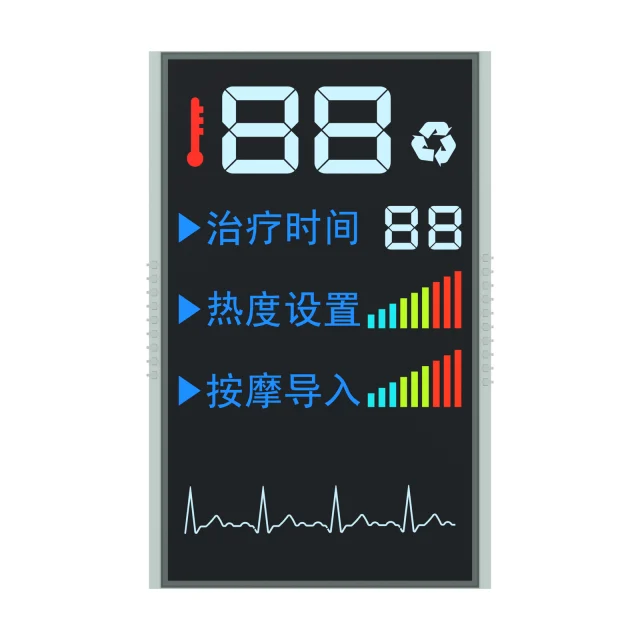
When an OEM replaces a VFD, SuccessLCD usually starts from a negative-mode segment LCD with a backlight, often VA, which shows lit segments on a dark background much like a VFD. SuccessLCD does not supply VFDs; it supplies the LCD side of the replacement.
How A VFD Works
A VFD is a vacuum tube shaped like a flat display. Inside the sealed glass are three electrode groups:
- Filament (cathode): thin heated wires that emit electrons.
- Grids: fine meshes that control and accelerate the electrons toward a digit or area.
- Anodes: the segments themselves, coated with phosphor that glows when electrons hit it.
Because it is emissive, a VFD needs a filament supply and anode and grid voltages that are higher than typical LCD drive voltages, plus a driver able to switch them. Its brightness and color are set by the phosphor, and colored filters can shift the visible color.
VFD Vs LCD Compared
| Point | VFD | Segment LCD |
|---|---|---|
| Light source | Emissive phosphor segments | Non-emissive; uses a backlight or ambient light |
| Typical look | Glowing segments on a dark background | Positive mode: dark segments on a light background. Negative mode: lit segments on a dark background |
| Viewing angle | Very wide | Depends on liquid crystal mode, polarizers and viewing direction |
| Drive electronics | Filament supply plus higher anode and grid voltages | Low-voltage AC drive from a segment driver, microcontroller or COG driver |
| Power | Filament and phosphor drive draw power continuously while lit | Glass itself draws very little; the backlight is the main load |
| Cold temperatures | Emissive, so readability is less affected by cold | Liquid crystal response slows in the cold; check the operating range and response time |
| Shape and artwork | Set by the tube design | Custom glass, artwork, icons and colors are routine |
| Ageing | Phosphor and filament ageing reduce brightness over time | Backlight LED ageing reduces brightness over time |
Why OEMs Replace VFDs With LCDs
- Supply. When an existing VFD becomes hard to source, a custom LCD can reproduce the same information layout in the same window.
- Lower voltages. Removing the filament supply and higher-voltage driver simplifies the power design.
- Power budget. A segment LCD with an efficient backlight, which can be dimmed, often fits battery or standby limits better.
- Thinner modules. An LCD and backlight usually take less depth than a vacuum tube.
- Design freedom. Icons, characters, colors and window shape can be changed on the glass and backlight.
How To Replace A VFD With An LCD
- Capture the existing display. Record the window size, every digit and icon, the viewing direction and photos of the lit display. A drawing or a sample of the old unit helps.
- Choose the optical look. For the glowing-on-black appearance, a negative-mode LCD with a backlight is the usual starting point; see VA vs IPS displays for why VA gives a deep black background. If dark-on-light is acceptable, a positive-mode or transflective LCD can be easier to read in bright light.
- Pick the backlight color and brightness. White, single-color or multi-color LED backlights are possible; review power and uniformity in the LCD backlight module guide.
- Replace the drive circuit. The VFD driver and its supplies are replaced by an LCD segment driver, a microcontroller with LCD drive or a COG LCD. This is usually the largest firmware and PCB change.
- Fit the mechanics. Choose pins, FPC or zebra connection to suit the board and enclosure; see FPC vs FFC and LCD connection types.
- Check the temperature range. If the product works in the cold, review response time and operating range; see LCD cold response time.
- Validate samples. Compare readability against the original in the real lighting and temperature. The LCD module sample validation checklist covers the steps.
For broader replacement planning, see LCD replacement solutions and the discontinued LCD module replacement guide.
Video: Negative-Mode LCD As A VFD Alternative
This short SuccessLCD explainer compares positive and negative-mode LCDs on real samples (S2873D, S1386D, S2238D, S2287D, S3131D and S1702D) and walks through the five steps of a VFD replacement.
SuccessLCD Negative-Mode Catalogue Examples
| Reference | Display | Notes |
|---|---|---|
| S1386D | VA negative-mode segment LCD for massage devices | 56 × 96 mm minimum viewing area, 19 rearward pins |
| S2238D | Compact VA negative-mode segment LCD | Battery, timer and dot-pattern character fields; FPC with 23 contacts |
| S2287D | Calendar LCD with two rows of three large digits | Negative transmissive optical mode |
| S3131D | Blue negative-mode STN elevator display | Direction arrows and two 16-segment characters |
| S1702D | Long blue negative-mode HTN treadmill display | 123.00 mm glass, 118.01 × 22.57 mm active area |
Artwork, optical mode and backlight are designed for each replacement project. See custom segment LCDs for the custom route.
VFD Vs LCD FAQs
What is the difference between a VFD and an LCD?
A VFD is an emissive vacuum tube display: phosphor segments glow when electrons from a heated filament hit them. An LCD is non-emissive: a liquid crystal layer blocks or passes light from a backlight or the room. VFDs are bright with wide viewing angles; LCDs use lower voltages and less power and are easier to customize.
Can an LCD look like a VFD?
Close to it. A negative-mode LCD with a backlight shows lit segments on a dark background, and a VA cell gives a particularly deep black. Backlight color can be chosen to resemble the original glow, but the look should be checked side by side with samples.
Is a VFD brighter than an LCD?
VFDs are emissive and typically very bright with wide viewing angles. An LCD’s brightness depends on its backlight and optical design, and readability also depends on reflections and viewing direction, so the comparison should be made in the real lighting.
Does SuccessLCD supply VFDs?
No. SuccessLCD supplies LCDs, including custom segment LCDs, monochrome LCD modules and TFT LCD modules. LCDs of these types are commonly used in place of VFDs when a product is redesigned.
What information is needed to replace a VFD with an LCD?
The window size and mounting, a photo or drawing of every digit and icon, the viewing direction, the operating temperature range, the available supply voltage and microcontroller, the target look (light-on-dark or dark-on-light) and the expected quantity.
Replacing a VFD in an existing product? Send photos of the lit display, the window drawing, temperature range and your controller details. See what to include in an RFQ or send your display requirements for an engineering review. For a replacement that fits the existing window, see custom LCD display projects.