
IPS Vs TFT Display: What Is The Difference?
Quick answer: IPS and TFT are not competing display types. TFT (thin-film transistor) describes the active-matrix backplane that switches each pixel. IPS (in-plane switching) describes how the liquid crystal is aligned and rotated inside each pixel. Most IPS screens are therefore TFT LCDs.
When people compare “IPS vs TFT”, they usually mean an IPS-type TFT LCD against an older or lower-cost TN-type TFT LCD. The IPS version keeps colors and contrast more consistent at wide viewing angles; the TN version is often cheaper but changes noticeably when viewed off-axis.
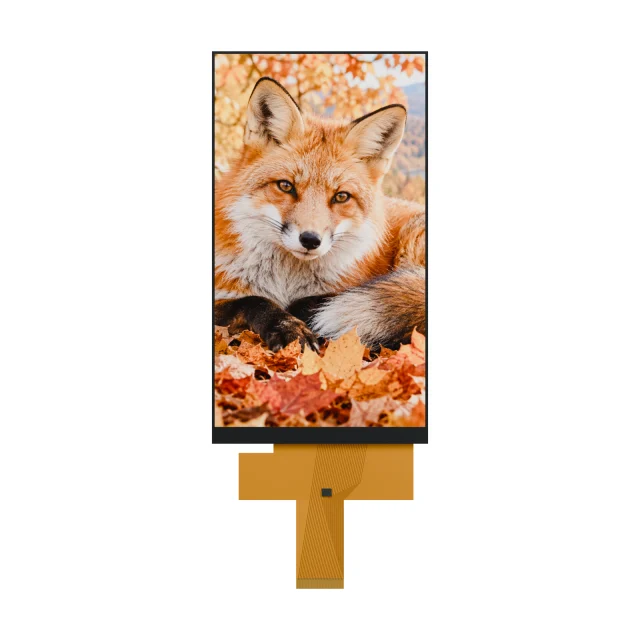
Backplane Vs Liquid-Crystal Mode
A TFT LCD has two separate design choices. The TFT backplane is the grid of transistors that holds each pixel’s voltage. The liquid-crystal mode decides how that voltage changes the light passing through the pixel. Common modes on TFT backplanes are TN (twisted nematic), IPS and its variants such as FFS, and VA (vertical alignment).
So a specification can read “TFT LCD, IPS” or “TFT LCD, TN” — both are TFT. Passive-matrix monochrome LCDs, by contrast, have no TFT backplane; see active-matrix vs passive-matrix LCD.
IPS-Type Vs TN-Type TFT LCD
| Factor | IPS-type TFT | TN-type TFT |
|---|---|---|
| Viewing angle | Wide and largely symmetric; little color or contrast shift | Narrower; image can darken or invert from some directions |
| Color consistency | More consistent across the screen and from different positions | Changes with viewing direction |
| Viewing direction | Usually no preferred direction to specify | A preferred viewing direction (for example 6 or 12 o’clock) must be chosen |
| Cost | Often higher for the same size | Often lower, widely available in small sizes |
| Brightness and power | May need more backlight power for the same luminance; compare at module level | Compare at module level and the same luminance |
| Typical fit | Handheld devices, HMI panels viewed from several positions, color-critical UI | Cost-sensitive products viewed from one fixed direction |
For a deeper comparison of response time, temperature and sourcing, see TN vs IPS LCD displays.
How To Choose For An OEM Product
- Map how the screen is viewed. If users see it from above, below or the side, or several people view it at once, start with IPS.
- Check the light conditions. Viewing angle does not fix glare. Review brightness, reflection and optical bonding, or see sunlight-readable TFT displays for outdoor use.
- Match the interface. The LC mode does not change the host interface; confirm RGB, LVDS, MIPI DSI or SPI with the TFT interface guide.
- Compare exact modules. Contrast, response time and power depend on the specific panel, backlight and drive conditions, not only on the label IPS or TN.
Video: IPS vs TFT Explained
This one-minute SuccessLCD explainer shows why IPS and TFT are different layers of the same LCD, compares IPS-type and TN-type TFTs, and lists the checks for an OEM product, with a real 3.5-inch IPS-type TFT sample.
IPS Vs TFT FAQs
Is IPS better than TFT?
The question compares different layers. IPS is a liquid-crystal mode usually built on a TFT backplane. An IPS-type TFT LCD generally has wider viewing angles and more consistent color than a TN-type TFT LCD, which is what most “IPS vs TFT” comparisons mean.
Is an IPS display a TFT display?
In almost all LCD products, yes. IPS LCD panels use a TFT active matrix to drive each pixel; IPS describes how the liquid crystal switches.
What does “TFT LCD” mean on a cheap display module?
It confirms an active-matrix color LCD but not the liquid-crystal mode. Many low-cost small TFT modules use TN. Check the datasheet for viewing angle figures or a stated IPS, TN or VA mode.
Is OLED the same as IPS?
No. OLED pixels emit their own light, while IPS is an LCD technology that needs a backlight. Both can be driven by a TFT backplane. See OLED vs TFT LCD.
Which should I choose for an industrial HMI?
If operators view the panel from different positions, an IPS-type TFT is usually the safer choice. Confirm brightness, temperature range, touch and interface for the exact module; see how to choose a TFT LCD for industrial HMI.
Choosing a TFT for your product? Related guides: VA vs IPS display, round TFT LCD displays, small TFT LCD comparison, OLED vs TFT LCD and LCD vs LED display. Browse TFT LCD module references or send your display requirements for an engineering review. For a non-standard outline, brightness or interface, see custom TFT display engineering.