
How To Compare Small TFT LCD Displays From 1.3 To 3.5 Inches
Quick answer: two small TFT LCDs with the same headline, for example 2.4 inches, 240 × 320 pixels and an SPI interface, can still differ in driver IC, panel type and viewing direction, brightness and backlight current, outline and active area, FPC pinout, touch panel, operating temperature and how the supplier controls revisions. Compare the full datasheets and drawings on those points, not just size and resolution.
SuccessLCD’s small TFT references run from 1.3 to 3.5 inches with SPI, MCU parallel, RGB and MIPI interfaces. For each project, SuccessLCD confirms the controlled drawing, pin assignment and initialization data together with the sample.
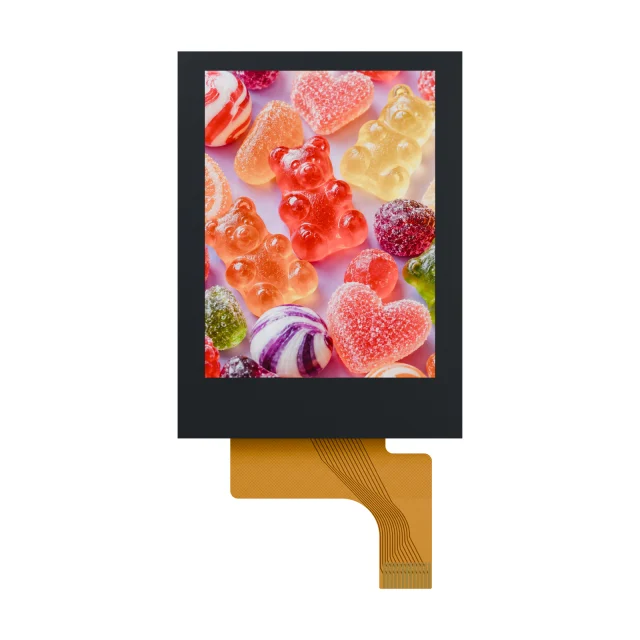
What To Compare Between Small TFT LCDs
| Parameter | Why it matters | What to ask for |
|---|---|---|
| Diagonal, outline and active area | The same diagonal can come with different outlines, bezels and active-area positions | Mechanical drawing with active area and tolerances |
| Resolution and orientation | Portrait-native and landscape-native panels scan differently | Native orientation and scan direction |
| Interface | Decides the host pins, frame rate and whether a frame buffer is needed | Supported modes: SPI, 8080 MCU parallel, RGB, MIPI DSI |
| Driver IC | Sets the command set, GRAM and supported interfaces | Driver name, revision and the supplier’s initialization code |
| Panel type and viewing direction | TN panels have a best viewing direction; IPS stays more uniform off axis | Viewing-angle figures and recommended viewing direction |
| Brightness and backlight | Indoor and outdoor readability, power and heat | Luminance (min and typical), LED current, backlight voltage |
| Touch | Changes the front stack, connector and firmware | Resistive or capacitive, controller, separate or shared FPC |
| FPC and connector | Pin count and order are not standard between suppliers | Pin assignment, pitch, contact side and connector part |
| Temperature range | Response slows and contrast changes in the cold | Operating and storage temperature range |
| Supply and revision control | Silent changes to glass, driver or backlight can break a design | Change notification process and controlled drawing revision |
SPI, MCU, RGB Or MIPI On A Small TFT
- SPI: very few host pins and simple wiring; the driver IC stores the image in its own memory. Full-screen refresh at higher resolutions is limited by the serial bandwidth.
- 8080 MCU parallel (8 or 16-bit): more pins but faster updates than SPI, still using the driver’s internal memory. Common on 2.4 to 3.5-inch modules driven by microcontrollers.
- RGB: the host streams pixels continuously, so it needs an LCD controller and a frame buffer, but supports smooth full-screen video. Often paired with SPI for initialization.
- MIPI DSI: a high-speed serial link for higher resolutions, used with application processors that have a DSI port.
For a deeper comparison, see the TFT LCD interface guide and MIPI vs LVDS vs RGB.
Driver ICs: Why ILI9341 And ST7789 Modules Are Not Interchangeable
Small TFTs are often described by their driver IC; the ILI9341 vs ST7789 vs ILI9488 comparison covers the most common ones in detail. Commonly seen examples in this size class include the ST7735 for 128 × 160 panels, the ILI9341 and ST7789 for 240 × 320 and 240 × 240 panels, and the ILI9488 for 320 × 480 panels. A few points to keep in mind:
- Same driver does not mean same module. Each panel needs its own initialization sequence, gamma, voltage and scan settings, supplied by the module maker.
- Different drivers need firmware changes. Even where two drivers support the same resolution and interface, their command sets and registers differ.
- Pinouts differ. The driver does not fix the FPC pin order; two modules with the same driver can have different connectors.
Driver IC names above are general examples. The driver for any SuccessLCD module is confirmed on its specification for the project.
SuccessLCD Small TFT Catalogue Examples
| Reference | Size | Resolution | Interface | Notes |
|---|---|---|---|---|
| S130MH2ZG-03 | 1.3-inch round | 240 × 240 | SPI / RGB / MCU | No touch fitted |
| S177MEHS-04 | 1.77-inch portrait | 128 × 160 | SPI | No touch fitted |
| S240MCQS-18P | 2.4-inch | 240 × 320 | 8-bit MCU | Resistive touch |
| S283MBVS1-01F1 | 2.8-inch | 480 × 640 | MIPI | Compact touch display |
| S350MLQZ | 3.5-inch | 320 × 240 | SPI + RGB | Without touch, or resistive touch variant |
| S35001D | 3.5-inch | 320 × 240 | RGB | Capacitive touch; 54-pin LCD FPC plus 10-pin touch FPC |
| S350FPQI | 3.5-inch transflective | 240 × 320 | SPI + RGB | Uses ambient light in bright conditions |
| S350FLVH-01 | 3.5-inch transflective | 480 × 640 | RGB + SPI | Higher resolution in the same size class |
Final specifications, connector and initialization data are confirmed for each project. Browse TFT LCD modules or round TFT LCD displays for more options.
Small TFT LCD FAQs
What is the difference between small TFT LCD screens from different brands?
Beyond size and resolution, small TFTs differ in driver IC and initialization data, panel type and viewing direction, brightness and backlight current, outline and active area, FPC pinout, touch panel, temperature range and revision control. These details decide whether a screen fits a design and whether it can be replaced later.
What is the difference between an SPI and an RGB TFT display?
An SPI TFT uses a few wires and stores the image in the driver IC’s memory, which keeps the host simple but limits full-screen refresh speed. An RGB TFT is fed pixel data continuously by a host LCD controller with a frame buffer, which supports smooth video but needs more pins and host resources.
Can I replace an ILI9341 display with an ST7789 display?
Not as a drop-in. Even at the same resolution and interface, the two drivers share the standard drawing commands but need different initialization, power and gamma settings, and the modules usually have different pinouts and outlines. Firmware, connector and mechanical fit all need to be checked.
Is IPS worth it on a small TFT?
If the screen will be viewed from several directions, or color consistency matters, IPS usually holds the image better than TN. If the viewing direction is fixed and cost matters most, a TN panel aligned to that direction can work well.
What resolution is typical for a 2.4 or 3.5-inch TFT?
240 × 320 is common at 2.4 inches, and 320 × 240 or 240 × 320 at 3.5 inches, with higher-resolution options such as 480 × 640 in the same size class. See the LCD resolution and aspect ratio guide for more.
Comparing small TFT modules for a design? Send the size, host interface, viewing direction, brightness target and enclosure details. See what to include in a TFT LCD module RFQ or send your display requirements for an engineering review. Browse TFT LCD display modules or see custom TFT display options.