
Optical Bonding Vs Air Gap LCD: Readability, Cost & Repair
Updated · Technical Guide Reviewed.
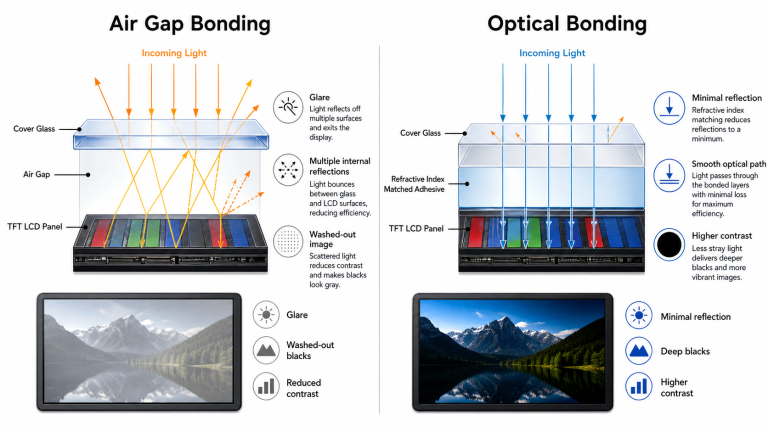
Optical bonding fills the gap between an LCD and a touch panel or cover lens with clear adhesive, reducing internal reflections. An air-gap LCD keeps those layers separated. The choice trades optical performance against assembly and service requirements; repairability depends on the adhesive, mechanical design and condition of the parts.
Optical Bonding Or Air Gap: The Short Answer
Evaluate optical bonding when reflections, parallax or condensation between layers limit the application. Consider an air gap when indoor readability is sufficient and access for repair matters. Compare the finished LCD, touch panel, cover lens and enclosure, including the agreed replacement method, before approving either construction.
Have a display project to review? Send your optical stack requirements.
On this page
Optical Bonding Vs Air Gap LCD
The main difference is whether the space between the display and front layer is filled with clear adhesive or left as air. That construction choice affects reflection, parallax, assembly, validation and serviceability.
| Decision Factor | Air-Gap Construction | Optical Bonding |
|---|---|---|
| Layer stack | A physical gap remains between the LCD and touch panel or cover lens. | Optically clear adhesive fills the gap and joins the front layers. |
| Reflection and contrast | More internal reflecting surfaces remain in the stack. | Fewer air-to-material interfaces can reduce internal reflections and improve perceived contrast. |
| Parallax and touch | The visible image and touch surface are physically farther apart. | The front stack is more closely integrated, which can reduce visible parallax. |
| Environment | Suitable when lighting and environmental exposure are controlled. | Worth reviewing for outdoor, mobile or demanding industrial use. It does not replace proper enclosure sealing. |
| Cost and service | Separate front-layer replacement may be possible if the mounting and seals allow access. | Rework depends on adhesive, access and component condition; some assemblies require complete-stack replacement. |
Repairability And Maintenance Cost
An air gap can make individual parts easier to access, but enclosure adhesive and seals still matter. Optical bonding is not automatically unrepairable: General Digital describes different rework behavior for silicone and epoxy bonds. VIA optronics describes controlled repair and rebonding for suitable, undamaged components. Confirm rework feasibility for the exact adhesive and module before quoting a repair.
| Service Decision | Ask For | Why It Matters |
|---|---|---|
| Replace A Damaged Front Layer | The replaceable unit and a documented disassembly or rework route. | A cover-lens repair and a complete display-stack replacement use different parts and labor. |
| Compare Lifetime Cost | Quotes for the initial assembly, inspection, repair or replacement, plus handling and downtime assumptions. | A lower initial assembly price does not establish the lower lifecycle cost. |
| Approve A Repaired Assembly | The repeat inspection and functional checks, acceptance criteria and responsibility for failed rework. | Optical appearance, touch behavior and sealing need confirmation after service. |
No universal repair price or payback period applies. Compare supplier quotes for the same stack, quantities, service boundary and acceptance criteria.
When Each Construction Makes Sense
Choose An Air Gap When
- The equipment operates indoors under controlled lighting.
- Some reflection and parallax are acceptable.
- The front stack is still changing during development.
- Lower cost, rework or field service is a priority.
Review Optical Bonding When
- Outdoor or high-ambient-light readability matters.
- A touch panel and custom cover lens form one HMI stack.
- Condensation, dust, vibration or front-stack rigidity creates risk.
- Perceived contrast and touch alignment affect safe operation.
For related decisions, review touch-panel and cover-lens requirements and the broader sunlight-readable TFT LCD approach. Higher backlight output and optical bonding solve different parts of the readability problem.
Validate The Finished Display Stack
Do not approve bonding from a supplier statement or product photo. Build and test the intended LCD, touch panel, cover lens and enclosure as one assembly. The validation plan should reflect the real application rather than a generic laboratory condition.
- Readability under defined ambient-light conditions
- Touch accuracy, glove and wet-operation requirements
- Cover-lens treatment, printing and viewing area
- Mechanical clearance and adhesive edge control
- Temperature and humidity exposure
- Vibration, impact and enclosure rigidity
- Cosmetic inspection and bubble criteria
- Repair, replacement and lifecycle plan
Prepare An Optical Stack Review
Start with the exact LCD reference from the TFT LCD Module Catalog. Send its available specification, the touch and cover-lens requirements, viewing environment, enclosure constraints, temperature, sample quantity and service plan. For broader integration, review Custom TFT LCD Engineering and organize the evidence with the TFT LCD RFQ Checklist.
Need Help Choosing The Front-Stack Construction?
SuccessLCD can review whether an air gap, optical bonding or another display-stack change fits the application before sample approval.
Request optical stack reviewOptical Bonding And Air-Gap FAQ
Does Optical Bonding Make An LCD Brighter?
No. Optical bonding does not increase the LCD backlight output. It fills the gap between front-stack layers with optically clear adhesive, which can reduce internal reflections and improve perceived contrast. Backlight brightness, surface treatment, cover glass and ambient light still need to be evaluated together.
When Is An Air-Gap LCD The Better Choice?
An air-gap LCD can be the better choice for indoor equipment with controlled lighting, modest optical requirements and a strong need for lower cost, easier rework or serviceability. The decision should still be checked against the touch panel, cover lens, enclosure and operating environment.
What Information Is Needed For An Optical Bonding Review?
Provide the LCD module part number and drawing, touch-panel and cover-lens details, required viewing environment, enclosure constraints, operating temperature, durability requirements, sample quantity and the specific readability or reliability problem the project needs to solve.


